N is for NPD (Narcissistic Personality Disorder) – Part 2
This post is part of the ongoing Alphabet Series. Listen along to my recording on YouTube and/or read the article below ♥♀
I did a little thinking after receiving an indignant and entitled comment from a YouTube user on the last post. He or possibly she was so disgusted at hearing a feminist perspective on NPD that they had to turn the recording off after a few minutes. The poor dear. I know, reality isn’t comfortable and can offend many people. People generally prefer lies and feel-good non-explanations for phenomena. But facing reality is necessary if you want to have any hope of actually solving problems. And NPD is a problem and does require a feminist framework if you want to understand it. So my thinking brought me to the following question – why must NPD be addressed within a feminist context? Very simply put, Patriarchy or the system male domination does the following. It pressures and enables women to pursue motherhood even if they are not equipped to produce or raise healthy children. It enables unhealthy men access to and control over women’s bodies and whatever comes out of those bodies. And it creates a problematic model of child ownership where an unhealthy parent or parental unit is solely in charge of a child or children without any accountability or external oversight. And outside of breeding, all societies reward aggressive and abusive male behaviour and allow women limited power if they exhibit or support male behaviour. How is this not problematic? This is a recipe for abuse, and it is only possible under a system of male domination.
Another reason why NPD is best viewed within a feminist framework is because of many of the similarities in treatment that a victim of a narcissist and a female in male-dominated society receive. Both narcissists and men in general are enabled and so many excuses are made for their abusive behaviour. Both victims of NPDs and women are gaslit and bullied when they try to come forward to describe their experience. Many of the tactics that narcissists use to control their victims are the same tactics that men use to control women. I’m not saying that all men are narcissists, but like I posited in Part I, I think that NPD is standard male domination patterns, but on steroids.
Early in my postgraduate training, I worked on various research projects on personality disorders, and since then I have done a lot of reading and exploration, as a survivor of narcissistic abuse, and I’ve never encountered a therapist or researcher that approaches these problems from a real feminist perspective. They can describe the issues, but they can never really provide adequate answers to the why and how questions, and thus, we can never develop preventative solutions. Psychologists just bandage the wounded. There are a few good reasons for this. First, all people are raised to elevate males and hate females and are inundated with woman-hate throughout their lives, and all psychological theories and resultant therapist training programs are rooted in misogynistic male thinking. So, true feminism isn’t going to make its way into therapeutic systems or even the education system. In addition, modern therapists who seek a following online do so primarily to make money. Adopting a fact-based, gynocentric approach to mental health (or any issue, really) is guaranteed NOT to make money. It can get you cancelled or put you in danger. If you alienate men, which can be achieved by simply calling them out on their provable, data-based violence, it will destroy any career you seek to build through social media. I’ve watched a lot of videos on YouTube on mental health issues, and even if the therapist him or herself understands the basics, they are ALL invested in promoting heterosexual relationships, and not a one will dare to touch sex bias in how women are affected by abuse or mental health issues, or will be truthful about root causes of anything. Some will touch on race and cultural issues, but no one will go near real feminism nor will they call out homophobic material left in their comments sections. I’ve even seen one or two ‘experts’ try to paint claims of sexism as oversensitivity rather than a legitimate complaint, which of course, is the kind of gaslighting that these people should be well aware of and that women experience constantly as the subordinate class in a patriarchal system. The failure to truly support women is not a surprise to me, but it is sad because as I’ve said many times before, suffering is not a necessary part of female existence and only happens because of male dominance and the system that results.
Okay, so having gotten that out of the way, I’ll briefly discuss the results of the poll I put on my blog and YouTube channel, and that will lead into the main topic
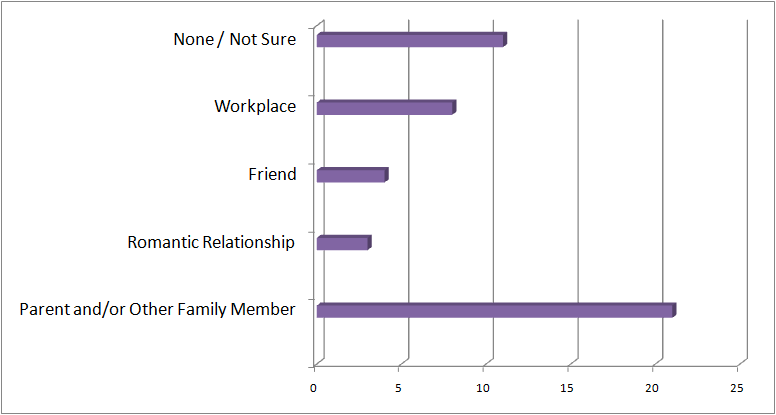
So I asked people to let me know in what areas of their lives they may have encountered someone with NPD just to get an idea of where we tend to encounter these folks. Note that the results are rough – I didn’t ask for confirmed diagnoses and the data are self-reported, so please don’t draw any causal relationships. But I will make a few observations.
First, I noticed that the most highly endorsed types of NPD relationships happened within families (especially with parents), and then in the workplace. This was interested and not unexpected. We don’t get to choose our families and are thus captive victims to whatever shit goes on there, especially in a world where breeding is not selective. If you want to escape NPD in your family, you have to go to very drastic measures, which I’ll get into in Part III. Workplace exposure has a little more freedom. You can leave a job, although depending on a host of factors in your life, it may not be the easiest transition. For some people, it may not be a big deal to find another job, but for others, you may be sacrificing your reputation or climb up a ladder or you may not have the financial means to quit without having something else in place. I firmly believe that women are more affected by abuse in the workplace, and our resumes and careers suffer when we are forced out of jobs due to stress and health issues, threats to our safety, and general career punishment simply for being women and especially outspoken or intelligent women who don’t follow lady-rules.
The other categories of friendship and romantic relationships were far less endorsed, and I think that is probably because we have so much more choice about these relationships. Unless you have been a chronically abused person who tends to fall victim to abusers, most people can avoid becoming trapped long-term in free choice relationships.
Of the types of treatment respondents experienced at the hands of NPDs, gaslighting was the most common, with blaming, boundary overstepping, and bullying closely following. NPD is about control and manipulation and protecting a very fragile ego at the expense of everyone else, and these tactics all serve to give the narcissist the upper hand in dealing with you, making you second-guess yourself and feeling like you have no control over what is happening.
So, let’s talk about the roles people in the lives of narcissists end up taking on. I’m going to address family and the workplace, primarily, but note that you can see some of these roles in any relationship with a narcissist. A lot of therapists talk about these roles as if each person involved in the system is assigned one, but it can be a little messier than that. Not all roles may be present. And there can be overlap and role exchange over time or situation. The roles can also have different effects on males and females.
The Truth-Teller vs the Enabler
When we talk about truth-tellers, we don’t mean the person who has no filter and just says what they think, no matter what. Rather, a truth-teller usually has high emotional intelligence and can often be described as being able to read a room or see through you. It’s a valuable skill that shows up in childhood, and as children, they’ll often bluntly state what they observe. Among normal people, this can be amusing or sometimes uncomfortable, but in a family with a narcissistic parent, an observant and truth-telling child is a massive threat. The narcissist feels shame and then reacts with rage and whatever punishing behaviours they use to regain the upper hand.
Truth-tellers quickly learn that pointing things out can get them into trouble, and many end up as loners (not always by choice) within a family, and later in the workplace. As children, they often have rich inner worlds, imaginary friends, escape fantasies, and dream of the day when they can exit the toxic prison they live in. Many truth-tellers end up becoming the family scapegoat and they usually have no support among family. They suffer anxiety and low-self-confidence and loneliness, although some may learn out of necessity to become extremely self-reliant.
I was the truth-teller in my family, and it has caused issues with NPDs in a few different workplaces, even affecting my career path. I swear I have the words tattooed on my forehead – people seem to know what I am even if I say nothing. Perhaps I am just not very good at ass-kissing or pretending to be blind to nonsense or outright abuse. I am also terrible at having superficial and/or subject-avoidant conversations, so much so that I’d rather have awkward silence than pretend. So it doesn’t surprise me that I prefer to work freelance or independently or with limited supervision. But I will say that I have managed to use what I consider to be an ability to great advantage in non-NPD situations requiring conflict resolution, and I feel it is somehow tied to my gut instinct when it comes to dealing with men who end up being threats.
Now, if the truth-teller is all about reality, then the enabler is all about lies. These are weak individuals, but they come in many flavours, and their actions serve to control their fear, keep the peace and/or protect the narcissist in return for rewards, safety, etc. I wrote a post on Enablers earlier in the Alphabet Series, so I won’t go into great detail here, but suffice it to say that these people are kind of like a shit topping on the shit-flavoured ice cream of the narcissist. The NPD abuses you, and then the enabler further harms you by shaming you and throwing in with the abuser. It should be no surprise that truth-tellers seldom end up becoming enablers.
The Scapegoat vs the Golden Child
A scapegoat is the person who is blamed when something goes wrong, even if they have nothing to do with it. Every narcissist needs a scapegoat because they never ever take responsibility for their bad behaviour, the mistakes they make, and they always need a target for their rage, even if no one specific is actually to blame. Truth-tellers often make convenient scapegoats because they are massive threats to the fragile NPD ego, and other family members may pile on as well to avoid being targeted themselves. But narcissists can target anyone for blame, even their greatest enablers. In some families, it is always the same person who is the scapegoat, but in others, members may each take a turn depending on the issue or their availability. And some people react to this treatment by trying harder to help or fix the situation, while others turn to bad behaviour to live up to negative expectations.
The golden child, on the other hand may exist in a family to serve a few purposes. The narcissist often places their hopes and dreams on someone, almost as if that child isn’t a separate person themselves. I’ve seen this play out in a few different ways, and there are often sex differences in how it works and how it affects the child. When the golden child is a girl, I find that she often ends up really neurotic and driven, plagued by severe anxiety, perfectionism, sometimes eating disorders. Later, in adulthood, these women can be a nightmare to work with, especially if you are female yourself. When the golden child is a boy, I often see lazy, privileged coasters. The parent talks about them as if they can do no wrong, and the boy gets used to the attention and the something-for-nothing treatment. As adults, these males expect the world to revolve around them, and they often get what they want because we live in a male-dominated world that rewards men for mediocrity anyhow. I’ve worked with both of these types of golden children; I even remember one male student I worked with in my undergraduate lab headed by an abusive NPD male psychologist was even nicknamed Golden Boy.
The other main purpose of a golden child is to use them as a weapon against threats to the narcissist. The golden child will be used as a standard to shame the other children, they’ll receive better treatment, more gifts or rewards, and more attention. There may be resentment among other children, and as a result, no bonds or alliances can form against the narcissist.
The Mascot vs the Lost Child
Like with the other pairs of roles, the mascot and the lost child are sort of opposites. These two roles are not about treatment, but how children may deal with a narcissistic person in the family. The mascot, which is a bit a strange term for me, tends to react to the constant tension and conflict in the family with a need to entertain. They seek attention and their aim is to break tension and make everyone feel better. It can be problematic later in life outside the family system as they don’t deal directly with problems and have developed a very thick wall of protection that can be hard to break down.
The lost child, on the other hand, doesn’t want attention at all. They retreat to avoid dealing with conflict. It doesn’t prevent them from being abused, however, but they don’t fight back or give the narcissist the satisfying ego boost they seek. They are more likely to be neglected, however. While the mascot may be able to get by in social situations later in life, the lost child may not develop the superficial social skills to ‘pass’ in workplace situations.
I’m going to close Part II here with the following. Although I didn’t go into great detail about each of the characters you may find in a narcissist’s life, you can probably see that there is nothing good that comes out of growing up in this kind of family or going on to work in a place where adults are abusing adults. It isn’t necessary, but it is inevitable when we live in a system where the right to breed trumps the right to live free of suffering. As it is abuse begets abuse. And in Part III, I’ll discuss how you can deal with narcissistic abuse, especially as a woman.
♀️ If you care to support Story Ending Never, we are appreciative. ⚢

Posted on December 2, 2023, in Feminism, The Alphabet Series and tagged narcissism, narcissistic personality disorder, psychology. Bookmark the permalink. Comments Off on N is for NPD (Narcissistic Personality Disorder) – Part 2.




 Story Ending Never
You must be logged in to post a comment.