O is for Ownership – Part II
This post is part of the ongoing Alphabet Series. Listen along to my recording on YouTube and/or read the article below ♥♀
You don’t own me
Don’t try to change me in any way…And please, when I go out with you
from “You Don’t Own Me” (1963) – a woman’s point-of-view on what she wants, written by two men. How unusual… And women, including the original singer, Lesley Gore, consider this to be ’empowering’…
Don’t put me on display..
I sometimes wonder whether what we loosely term ‘feminism’ is just another distraction orchestrated by men to keep women busy and feeling like they are fighting for something, but actually accomplishing nothing substantive. Case in point, like the song “You Don’t Own Me”, so many of what women consider to be ‘feminist anthems’ were written or co-written by men, and the message is almost always “I want to keep serving you, but I have limits to the abuse I’ll take from you. So I’m gonna get mad and stamp my feet, and you’ll have to make some empty promises, so that I can keep telling myself that men are worth saving. Then, things will go back to the way they were, for the most part. But at least you don’t own me.”
Well, I’m going to save a discussion of lady-empowerment songs for another time, but the bottom line here is that women’s publicly aired anger at and frustration with men doesn’t mean a damned thing if, at the end of the day, they all still go back to sucking their dicks and accepting minor or temporary concessions or a few minutes of penile attention as proof of respect or love. The only thing men understand besides violence, is denial of service. And very few women are willing to take their anger that far, even though cutting off the gynergy fountain isn’t in any way a violent or extreme solution. Men allow certain feminist distractions, such as the pursuit of elusive equality between the sexes, but not liberation. But it is empowering to sing men’s words and pretend that they change our lives, I suppose.
But anyhow, let’s get back to the topic at hand: ownership.
It is clear, if you live in the world and are a thinking woman, that males and females define ownership (and many other concepts for that matter) differently. But it is always men’s definitions that matter, even if they are irrelevant or even harmful to women. Men define how we live, what we are allowed to have access to, what we think and say and do, and as I mentioned above, they even orchestrate our sociopolitical beliefs and movements. Many women end up going along to get along because it is easier, less dangerous, and more profitable. Those who dare to define their parameters or even to just question the male paradigm end up being outcasts and worse. So as a result, we still don’t fully understand what ownership means to women, just as we don’t understand female sexuality, female abilities, or female psychology. So in various senses of the word, men own women’s realities. I did a cursory look for any research on sex differences in the understanding of ownership, and I found one. It was authored by a man, of course, and it hails from Canada, and dates back to 1994. So obviously, this is a hot topic. Without going into a lot of detail, I’ll summarize dude’s findings with the following examples of typical male and female thinking on ownership:
Male: That shit is mine and mine alone. If you touch it, there will be repercussions because you’re violating my right as a man to have this shit.
Female: In owning this shit, I feel a sense of responsibility, pride and connectedness with myself, others and the world.
And it may be no surprise to you – and we see this in tons of psychological research on sex differences on a whole range of issues – that men are, generally speaking, simplistic, black-and-white, self-centred, entitled thinkers. Women, on the other hand, are deeper, more complex and nuanced thinkers. I can’t help but be reminded, yet again, of how male neglect and dismissal of women’s thinking and psychology has likely held back the development of societies around the world throughout history, and has hastened the destruction of the planet. If this conclusion pisses you off, please note that I’m not saying anything new here, although perhaps more bluntly than you’re used to – men demonstrate how they operate every single day, and their thinking is present in how every single society is structured and operates. Whether on a personal, local, or national level, ownership in the eyes and minds of men is an exclusive right to enjoy, use or abuse that which one claims as one’s own, at will, and to use force to defend it.
Ownership is a vast topic, and I’d love to teach a college-level course on it. Some of the sub-topics would include: the history of marriage, the slavery of women, and the concept of the body as property and a product to be owned, rented, marketed and traded. We could explore the limits of female ownership, especially the interesting contradiction mothers often post in asserting ownership of their children without interference from the government or the public, yet expecting society to foot the bills associated with this privilege. And then, we could explore other forms of human ownership – that of group slavery throughout history – which stems from male ownership of females, although the latter is generally NOT acknowledged as ownership for very obvious reasons. We could also talk about ownership in a political sense from the point of view of capitalism and consumerism, libertarianism, anarchism, socialism, and communism, and how poverty and some element of ownership are major issues in each of those systems. There is also the geopolitical issue of country-formation and border defence. The only reason we have countries is because of men’s need to own everything under the sun. And war is a direct result of men’s need to own land, culture and people. We could then get into more modern ethical issues of patents and copyright, and whether anyone has the right to own and control water sources or plant life or ideas or words. And there is so much more. I think it would be a fascinating multidisciplinary course, but I don’t think it would be allowed these days, especially if taught by a woman.
Now, I can’t address all of that here in this post, although some topics may appear in later Alphabet Series articles, but I’ll talk briefly about a few issues surrounding property ownership.
I remember when I was 17, my mother was studying to become a real estate agent, which was kind of funny because she’d never worked hard for anything in her life, including in her career as a mother and housewife, and she had no clue how much time agents had to put into the job if they wanted to build a profitable career. Needless to say, that job never panned out for her, but she was fine even following divorce – she did what works for many women, she was supported through alimony and child support that didn’t go to supporting children, and then went on the prowl for a wealthy man. She eventually found one, and luckily, he died after a few years and left her a pile of money. If you have a lazy nature and can stomach being a man’s whore, then this is the best and easiest route to surviving as a woman in this world. Be offended, if you wish, but I’m stating a blunt truth about how this world works.
So, one day, I was sitting outside the back of the family home with my mother and father who was still living with us, and mother said to me: “Here’s what you should do. You should buy a house and rent out the rooms to pay the mortgage.” Basically, an investment strategy, that is much more common now than it was in the 1980’s. I remember looking at her then, and I didn’t have a response. Well, I had learned not to have a response to anything she said because she was a clinical narcissist and any questioning or disagreement could lead to punishment and other insanity. But over the years, and still remembering that nugget of ignorant wisdom imparted to me, I have a response. First, I’d never qualify for a mortgage in Canada. Never have, never will. It’s difficult if you’re not a conventional person with a stable and high income. Second, despite my parents buying their first home only because their parents gave them money to afford it, I know my parents would NEVER have helped me. And I was cut out of all family inheritances by my mother when I was 20. Third, I don’t believe in buying things that I can’t pay for outright – debt is akin to imprisonment, in my opinion. I’ve been dirt poor, but I’ve never been in debt. And finally, over the years, I’ve come to agree with anarchist and communist thinking that landlords are a scourge, and as I see more of the world and note how fucked up life is becoming for poor people in so-called ‘privileged’ countries, such as my own, these beliefs have become firmer. I have no problem whatsoever with private property ownership, which I’ll talk more about below, but I have very specific ideas about how money should be earned, what should never be an income source, and the necessity for safe, affordable housing for all people.

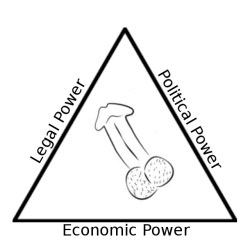
No woman is safe. Owning property and having money helps and gives you options, which can be the difference between life and death in some cases, but it doesn’t guarantee safety or freedom from men. Ownership is the domain of men. It is the basis of their hierarchy of power – the more they own, the more power they have. Women don’t exist on the same hierarchy. We’re not allowed to own much, including our own bodies, although to some extent, women can own the children they produce. We are more likely to own property and things through orbiting males or gaining family help, including inheritance, but it doesn’t help us escape our sexual subordination in the world. I talk about this more in my post, M is for Mother.
Further, when you orbit a male, you, and by extension, everything you own, is owned by him. This is the history of the world. Once upon a time, a man could rape you and own you. In some cultures, you’d be dirtied and have no choice but to marry him. In other cultures – and this is still happening today in places such as Kyrgyzstan and rural China, a man can abduct a woman or girl, rape her, and own her because she has no escape. In many cultures, once the rape or abduct and marry scheme fell out of fashion, families mostly just resorted to selling their daughters to men. Sometimes complete strangers to the girl, sometimes, distant family members or friends of the family. And different cultures had different names and practices for this financial transaction. And any property or belongings women brought to the marriage became the property of the husband. The best part of this change of ownership is that it has been sold as a female invention, has often being described as a scheme to trap men, and throughout history has been bolstered by denying women access to education and the job market and leaving them dependent on marriage for survival. Cultures have evolved fairy tales and other propaganda that are fed to little girls to romanticize being swept away by Prince Charming, and to see their wedding day as the best day of their life. Over time, brides themselves have become the ones to plan their own slavery, to pour energy into organizing their wedding event, with males wasting no energy at all in an institution that was designed by them, for them. And even today, the wedding industrial complex is one of the most profitable patriarchal inventions on the planet, and women, despite being allow to participate in society and achieve financial freedom, still choose to be owned. Every married woman that I know – and there aren’t many anymore – is smart and capable except when it comes to her marriage or partnership. The men own their attention, energy and time, and it amazes me when an otherwise independent female friend will turn down or cancel a plan with me because she is afraid of being punished by her male partner for denying him attention. Slavery exists and it’s called heterosexuality, in my experience.
Getting back to property ownership, there are all sorts of facts and figures out there about how much of the world’s property women actually own. It gets confusing because surveys don’t measure how women get property. I’d bet that most of the time, women gain land through orbiting men and they either co-own, have the property put in their name, or they win it in a divorce, buy it with the money won in divorce proceedings, or their owner dies and they inherit land. Women may also inherit property from family or get help from family in making a purchase. What we do know is that never-married single women are the least likely to own property, and they are the only group of women with a sex gap in % of ownership compared to men. Married, divorced and widowed women in the US have closed the gap in property ownership over the last 30 years. When you don’t orbit cock, you still don’t earn as much as men and don’t benefit from a male salary.
It is interesting to look at property ownership internationally. Contrary to what many people think and the stereotypes they may have, property ownership isn’t more common in wealthier countries. Almost none of the countries with 80%+ home ownership is a wealthy country. If you look at the ratio of owner-occupied units to total residential units, you see a reflection of a combination of government policy, property prices, ease in getting mortgages, level of interest rates, and societal mentality on home-buying. Laos and Romania have about 96% home ownership. Ninety percent of Cubans and Chinese own their dwelling. Canada and the US sit at about 66%. And just over half of Japanese homes are owned. And speaking for my own country, up to 6% of our homes are owned by foreign investors currently. This has likely had a negative effect on lower-income, local, potential home-buyers, and I know that many younger people in Canada can’t even wrap their heads around the idea of trying to buy property. Myself, I remember working for a short, agonizing spell in a private kindergarten in China catering to rich people, and I met one mother who told me she had just bought a house in one of Canada’s most expensive cities over the internet. She’d never even been to Canada before. And the last time I was in Canada, I was renting a room in a house that was put up for sale. Chinese real estate agents were coming through the house doing a video tour with foreign buyers. Canada recently implemented a foreign buyer ban, which has been extended to 2027, but I think the damage to the housing market has already been done. And whether foreign or local, unlike in the past, landlords these days believe that renters exist to pay mortgages and should absorb the costs of interest hikes. Shameful.
Conclusion: You already know what I think about marriage and that I have a real problem with child ownership, as well, and there really is no solution to freeing women as a class if most are content with complaining about male dominance in their relationships, yet are still continuing to support them in all possible ways. Women could change the structure of the world if they stopped supporting traditional male ownership models, as promoted in a heterosexual lifestyle. It’s pretty simple, actually. The housing and property ownership issue is probably equally unsolvable as long as people support capitalism and believe in earning money for doing nothing. Housing is one of those basic needs like food, basic healthcare, and safety, that shouldn’t be something people struggle to achieve. And when I say housing, I mean safe, quality housing. Not the warehousing concept that became a problem under some communist regimes or that currently happens among the very poor in Western countries, and especially in places like Hong Kong, where too many people are forced to share an inadequate space despite being strangers. I also think women should be able to access housing complexes, neighbourhoods, and even entire towns where they can live free of men in safe, clean housing. I’d love to see what I touched on in my post: I Want My Own Vatican City. A country of women and girls, for women and girls, but without the religion 😉
♀️ If you care to support Story Ending Never, we are appreciative. ⚢
Rudmin, Floyd W. (1994) Gender differences in the semantics of ownership: A quantitative phenomenological survey study. Journal of Economic Psychology, 15(3), 487-510.

Posted on February 25, 2024, in Feminism, Male Privilege, Misogyny, The Alphabet Series and tagged marriage, ownership. Bookmark the permalink. Comments Off on O is for Ownership – Part II.



 Story Ending Never
You must be logged in to post a comment.