Blog Archives
I is for Identity
Posted by storyending
This post is part of the ongoing Alphabet Series. Listen along to my recording on YouTube and/or read the article below ♥♀
Welcome to a topic that is the root of serious depression for a minority of people, the inspiration of hate and violence for some, a really sore or touchy or confusing subject for many, and a nebulous and frequently changing state for most.
Yep, like I said, I is for Identity.
The concept of identity – or how we are defined as a person – has been part of the human timeline for millennia. But it isn’t until recently that it has taken on a significance that borders on the clinically obsessive. It really didn’t used to be that way – heavy and gooey and taking up way too much mental real estate. In the beginning, it was used to be simple, rooted in basic biological and situational facts. It used to centre on standing in society and for men, the ownership of women, children, animals and things. And for women, identity was exclusively wrapped up in who owned them.
Along with “Why am I here?”, “Who am I?” has likely been asked by people all over the world since humans were capable of complex thought. But possibly, believing that everything in one’s life was fixed and little could be changed, as well as a tendency towards superstitious and magical thinking, the questions didn’t really go anywhere or inspire angst or tumultuous life changes in those to whom the questions presented themselves. I mean, what could they do? Considering complex ideas and behaving outside the norm could be very dangerous and get you ostracized from society or even get you killed.
For most of human existence, identity has only served a few simple, explicit, and practical purposes. Being able to recognize friends or foes and human property (women) through physical or symbolic markers; maintaining a memory or history of one’s tribe; and creating a sense of purpose and belonging as a community have been a few of the more important reasons for establishing formal means of defining identity. I am not going to focus on the historical development of identity here – it is, as usual, a massive topic. Rather, I want to look at the mess that is identity today because it has unfortunately become politicized, and has increased to include constructed affiliations that have been greatly inflated in importance, but that have fuelled all sorts of hate, violence and general unfairness. And the mess I’m talking about is social or personal identity.
It was likely only within the last 100 years that social or personal identity became something that started weighing heavily on people’s minds, taking up precious time and energy. It was probably partially thanks to our comparative economic and lifestyle freedom coupled with the machinations of modern social psychologists in their need to create, I mean study social problems, that really pushed the human brain into overdrive and into a focus on things that are probably so much less important than we think they are. Now, we have what some would sarcastically call ‘First World problems” – a shit ton of psychological and social issues that wouldn’t exist if we were still forced to focus on day-to-day survival. I don’t want to pooh-pooh psychological problems – they are real to those who suffer from them and cause an immense amount of harm both to sufferers and to society in many ways – I’m just saying that these problems have been constructed and don’t actually need to exist.
Biological Essentialism, Relatively Static States, and Social Constructionism
These days, identity can come from a variety of sources, and I think that socially constructed identity is mostly designed to create division and provide a rationale for oppression and male violence. A few aspects of how we are defined are based solely in biology. Sex is one of those identity markers that is irrefutably biological, despite what trans activists have tried to make us believe in the last couple of decades. It puts all humans into two defining categories that haven’t changed over time or across cultures: predators and prey, or simply, males and females. The fact that this doesn’t vary is proof enough that sex is biological. Gender, on the other hand, is one of those factors that is 100% constructed. And confusing sex and gender has been the agenda of post-modernists and trans activists and other misogynists as backlash to feminism. If you can make people believe that women are biologically wired to be subservient and salivate over being raped, you can justify anything men do to them and keep them from achieving any kind of liberation. I do hold an essentialist view, based on copious data, that males are wired for violence. And remember that oppressors call the shots and so it is males, not females, who are allowed to act naturally. But I also believe that males are allowed to hold onto that violence because they socially constructed gender and the various systems that reward men for their violence and punish women for rebelling.
Plenty of other factors in modern conceptions of identity are socially constructed. National borders, the stuff upon which national identity is based and the stuff aspiring dictators and crafty politicians use to fuel war machines and unwarranted xenophobia, is constructed and unnecessary. Religion is completely socially constructed, based on fear and ignorance, the need to control groups of people and to justify the hatred of women. Gender, like I said, is completely constructed and is used to justify the oppression of women. Sexuality is mostly constructed, and the institution or system of heterosexuality was created to oppress women and create armies used to maintain violent male agendas. Race is biological, but a socially constructed element was added to artifically create more differences between racial groups than actually exist and to fuel woman hate and satisfy male war-lust. Culture is socially constructed, by definition, and like religion, has become protected, given undeserved respect and is thus, untouchable, despite the fact that culture is just how the oppression of women manifests in a given time and place.
There are also what I call factually-based or static-state contributors to identity. They are not things we are necessarily born into, and they don’t form the basis of activism or oppression. But they develop as we grow up, don’t change a great deal, and for many, become crucial to our identities. These can be professional identities, hobbies and the like. I can speak for myself when I say that my work is crucial to how I define myself, and how I perform or contribute has great impact on my psychological health and my sense of purpose. I also derive some sense of identity from my great love of bees. These are things that I wasn’t born with, although they may be a result of my personality and thus are a part of me that likely won’t change much over the course of my life.
How Did Social Constructionism Gain So Much Power?
I think social constructionism is a logical outcome of a modern, decadent and frivolous world where the majority of people lack meaningful purpose and are suffering as a result. I’m going to give social psychologists the very slightest of benefits of doubt in that they were probably trying to help people deal with their modern world problems and associated emptiness, but as with everything men do, they ended up creating more problems than they solved. The whole identity crisis problem likely started very small, then snowballed and has finally ended up turning the last few generations into oversensitive, fragile, narcissistic, specialness-seeking, trigger-warning-needing, FOMO-prone, selective social justice warriors. There is a need to feel special and validated like at no time before in history, and the creation of new and more insane identities has become both an obsession and even an occupation for many.
What I can’t figure out is whether all of this is the result of the need to escape or avoid a lot of large and very real crises and inequalities by creating a host of non-problems and oppressions to focus on, or whether having a highly distracted and emotional population is exactly what is needed in our current business and political climate. I’m not a conspiracy theorist, but I’ll say that there is probably a bit of both elements going on. And then like the proverbial out-of-control snowball rolling down the hill, identity politicking has taken on a life of its own, infiltrating every aspect of our lives, including the political, and feeding itself via the internet.
Identity Becomes Brand
To a certain extent, ‘brand’ has always existed although not in the way that we understand it today. Women have always been owned with no choice about being a thing to be sold, and thus their identities have always been constructed by those who own them. But we’re at a point where it has become an honest to goodness goal for young and amibitious people to deliberately turn who they are – their very identities – into a saleable product or service. And the name of the game is inauthenticity with a slick veneer of hope. With the rise of social media, this has become big business. Personally, I find it strange and repulsive, although because of my interest in propaganda, brainwashing, and ethics, I also find this unfortunate development morbidly fascinating. In the history of business, marketing has never been about truth. I tend to think that if something needs to be marketed, you don’t actually need it, and the purpose of marketing is to convince you that you need the unnecessary. So of course, capitalism, the system of selling for profit, depends heavily on marketing, and is therefore a system built upon lies, and its brothers, dehumanization and inequality. Capitalism’s appeal is in its ability to sell, not just every product you could possible dream of, but also the promises of and hope for wealth, happiness, a better life, social approval and the like. All lies and illusions.
So, as I said, we’re at the point where people are constructing identities and selling them for profit. They have manifested as cult leaders, gurus, and most recently, influencers. It seems that the greater the focus we place on identity, the further away from being real we become. Real people don’t really make for a good ‘package deal’ as their true identities tend to look messy or unmanicured or just plain old boring. People want to buy or buy into identities that look good on the surface, that can cover up both internal and external messiness (aka reality), that will distract from boredom, and that will buy them social credit in an increasingly inauthentic world.
Conclusion
I’m a pretty hard core minimalist in most areas of my life, and my philosophy is that less is more, except perhaps when it comes to learning. Then, I think you can never get enough. But in the topic today, I really think a serious paring down is required to avoid becoming consumed by what you think you’re supposed to be. How do you do this? First, get off the internet! And yes, I see the irony in what I’m saying. Okay, well at least limit your plugged in time. The internet is a mind-fuck if you veer off the path of educational sites and into social media and other time-wasters. Next, focus on learning, and develop your meaningful purpose. I’ve talked about this before, so I won’t go into detail here. These are places to start. Keep it simple and you’ll find less nonsense finding its way into your quest to define yourself.
So, I’ll end with this question: who are you?
♀️ If you care to support Story Ending Never, we are appreciative. ⚢
Share this:
- Click to share on X (Opens in new window) X
- Click to share on Reddit (Opens in new window) Reddit
- Click to share on Facebook (Opens in new window) Facebook
- Click to share on Tumblr (Opens in new window) Tumblr
- Click to share on Pinterest (Opens in new window) Pinterest
- Click to share on Pocket (Opens in new window) Pocket
- Click to email a link to a friend (Opens in new window) Email
- Click to print (Opens in new window) Print
Posted in Feminism, Language, Patriarchy, The Alphabet Series
Comments Off on I is for Identity
Tags: culture, essentialism, identity, psychology, radical feminism, social construction, women
It Takes a Village
Posted by storyending
[First, a big shout out to all the trans who popped over from Facebook for a visit to learn about how you are using your male entitlement and natural, biological propensity for narcissism, violence and misogyny in order to abuse women and take away hard-earned rights. I’m sorry I don’t allow comments on this site, so you likely had to limit your rape and death threats (you know, male violence against women) to the Facebook vacuum and whatever space exists between the ears. But anyhow, thanks for the blog hits, boys! Traffic is always appreciated, and as an educator and life-long learner, I fully and sincerely endorse your commitment to information-seeking. I hope I could help.]
This current post has nothing to do with trans issues. It was inspired by last night’s short venture out to find some food as my apartment’s fridge was empty except for a green pepper and a small jar of hot chili paste care of a friend from Hunan province. The post was also inspired by the latest posts by and subsequent back and forth on essentialism and socialization with other bloggers.
This post got published and then sent to draft since I thought it was too long, and now I’ve reworked it into something more digestible (maybe).
Background: Children
I don’t like kids, generally speaking. There, I said it. I’m the fucking devil, and I can sense hackles rising around the world as people dig in for a full-scale, personal attack on their individual little monsters. Advice: if you’re getting pissy, don’t throw a hissy. I’ve managed not to kill anyone even though I’ve had it up to here (here being really far up my ass) with mostly women and the occasional douchbag mansplaining man giving me all kinds of nasties about wanting to be childless since I was yay tall (yay tall being about the level of where my ass hangs now) and then achieving it. You like kids, I don’t. Who cares? Although I suspect there are plenty of people who don’t like kids who have ’em. I’ve met plenty. And I say, poor kids. I know first hand what that feels like.
Background: Families
The family unit is one of the worst social inventions men have ever come up with in history. It is solely based on and only survives because of a slavery or ownership model. Traditionally, the man of the household owns the home and assets, including his sex and domestic slave (wife) and all children, whether blood-spawn or adopted. He may also have dominion over other female and under-aged relatives. And he can do whatever he pleases with them as they are all trapped there and meant to serve with a smile. The family unit provides the easiest and cheapest possible way for a man to repeatedly access human prey (women and children). The family unit is the most effective way to hobble a woman and destroy her from the inside out in a long, drawn-out sorta way. And the family unit is the worst possible government-sanctioned environment in which to socialize a child (maybe aside from an orphanage). I’m very much of the village model in child raising. That old proverb (origin unknown, common in many older cultures) “it takes a village” has value. Everyone should have some responsibility in ensuring a child becomes an upstanding citizen, although I’m also in favour of keeping men away from children, especially girls, as they inevitably promote patriarchy and good ole male dominance and female inferiority, and frequently turn to them for sexual amusement.
Somewhere along the way in the family model, we’ve run across things like jumping to conclusions about parents based on limited evidence of something ‘going wrong’. Appearances can be deceiving. We also have a shitload of parents who a) are overworked and absent and who try to assuage guilt by trying to be their children’s friends rather than their parents or by buying them off or mollycoddling them (a sad inevitability of capitalism and the pursuit of wealth/excess), and b) are so out of touch with current society/rape culture that they have no idea the kinds of stuff their children are getting involved with or accessing (porn, drugs, sex, violence, gangs). Kids are disconnected, community members don’t care what’s happening unless they are finger-pointing at parents (which isn’t constructive) or guarding their shit. Moral systems and social/human connectedness need to be a group effort. When everyone feels invested in children, children see themselves as worthy and invest back – everyone wins, and a group effort means less work for all.
Background: Animal Abuse
I love animals. I like them better than people for the most part. Along with pro-lifers and rapists and pedophiles and pornographers and prostitute users, there is a special place on my shit list for animal abusers. When I was five, we came back home to where my stay-at-home mum was imprisoned to find our dog locked in the basement with duct tape wound tightly around her muzzle. For how long? Hours? All day? Mum hated animals and children, and I’m glad patriarchy and a controlling husband provided her with unwanted children and an unwanted pet and then forced her to stay home with them 24/7. Still, she gets some blame here – she was a chronic, narcissistic abuser in addition to being a victim, and no abuser gets a free pass in my world. To this day, I try to protect animals when I can to make up for mother’s sins.
And being informed is important. I forced myself to watch “Earthlings” (everyone should – it’s horrific) and cried my way through it just like I do documentaries on porn and human sex trafficking.
Bringing it all together
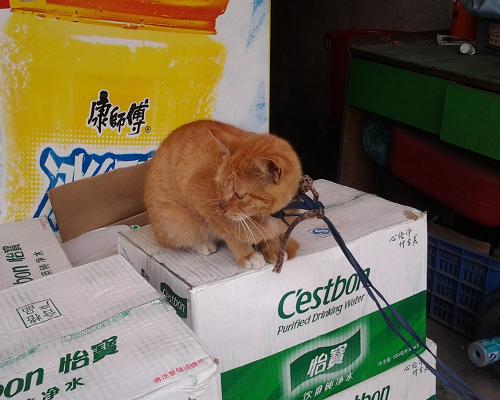
So last night, I donned my hazmat suit to protect me from my usual dose of misogynistic racism that I’m gifted with whenever I go outdoors, and ventured into the commercial area near my residence. It was early dark. I stood at the corner waiting for the light to change and looked back over my shoulder at the little fruit shop I sometimes go to. In the summer, one of the employees got a sweet little orange kitten (I have a very soft spot for the oranges), which they kept tethered at the side of the shop. Recently, since she has grown quite a bit in size, they’ve been tying her up at the front of the shop to two cement blocks (see the second photo). where, she can sit front and centre for all to admire, interact with, and unfortunately, abuse.

Animals are seen differently in China than they are in the West. Only recently have people started adopting a ‘pet mentality’ similar to, but not as prevalent as in, the West. Really, pets are just domesticated animal slaves. We are emotionally attached to them, but we have done more harm than good, I think, in changing them in very fundamental ways. I say this as a domesticated animal lover. Humans are selfish. Anyhow, in China, there still is quite a difference in how animals are viewed and treated. I find that many ‘pets’ I encounter are quite a bit different from the pets of my Western friends. Although I am a ‘toucher’ (I can’t keep my hands off animals if they approach and want to be petted), I seldom touch animals in China. First, they are a bit feral, not human-oriented, and they generally don’t approach humans. Affection isn’t common among humans (it is amazing how many of my undergrads have never said ‘I love you’ to their parents or heard it from their parents). And it isn’t really common with animals either. And second, they are generally dirty and often diseased. One of my students died of rabies a few years back when his pet cat bit him. It’s not so uncommon in southern China. I’d prefer not to die of rabies.
But this little orange cat, although very dirty, is incredibly friendly and loves to be petted. So I oblige. It appears to be mutually beneficial.
Now when I turned back while standing at the traffic lights, I saw the little orange tethered to and sitting atop the cement blocks. In a circle surrounding her was a group of children, mostly boys with a couple of girls. They were young, ranging in age from about 5 to 8. One adult man – one of the fathers? – was looking on wielding a cell phone camera capturing the hijinks. And there were other adults, including the shop owner, the cat owner, and various workers standing around. The children were tormenting the cat. Smacking her. Dropping garbage on her. Poking her. And laughing their asses off. I was horrified. The cat was cringing, terrified, flattening herself to the cement block, realizing there was nowhere for her to go. I was surprised she wasn’t hissing or trying to bite/scratch. And it went on and on. I noticed the adults didn’t give a shit. I don’t really like the word ‘triggered’, but I think at that moment, I was triggered. All I could see, despite the young age of these little shits and despite the tormented object being a young cat, was a group of men torturing a woman prior to raping and or beating her to death. It was just so fucking familiar from porn, from mainstream film, and even from actual video from places where male mobs attack lone women for some bullshit infraction like wearing the wrong clothes. I couldn’t walk away. So I stomped over to put a stop to the bullshit. Very, very un-Chinese. I broke social rules with that one decision. The rule here is not to intervene when you see something wrong, when a person you don’t know needs help. But you can stare all you want. I called bullshit and moved in. Luckily, I speak some Chinese, so I told them Enough! This is a good cat. Be nice. And I demonstrated how to pet her. Immediately, the cat’s posture normalized a little. The kids were freaked to have a foreign person in their face. And I waited for them to go away. I don’t know if they got the message. They did realize, however, that fun times were over.
I feel I’m part of the village, even in this distant land, that needs to contribute to socializing, instilling humanity and perspective-taking and valuing life in the young. How can they grow up to be decent people if they don’t learn? The problem is this, though. I was the only one who saw what was going on as wrong, or at least the only one willing to demonstrate that I saw it as wrong. If the patriarchal ‘village’ doesn’t see violence against women, children, animals, (pick a group) as wrong, how will children learn? And further, the sadistic tendencies in this mostly-male group of children are unfortunately biological, so can they actually learn and truly understand that sadism is wrong, even if the correct socialization is in place…?
There is more to think about here. But in the meantime, I feel like going on a cat rescue mission. I wish I had a stable enough lifestyle to support a cat.
Share this:
- Click to share on X (Opens in new window) X
- Click to share on Reddit (Opens in new window) Reddit
- Click to share on Facebook (Opens in new window) Facebook
- Click to share on Tumblr (Opens in new window) Tumblr
- Click to share on Pinterest (Opens in new window) Pinterest
- Click to share on Pocket (Opens in new window) Pocket
- Click to email a link to a friend (Opens in new window) Email
- Click to print (Opens in new window) Print
Posted in Education, Feminism, Violence
Comments Off on It Takes a Village
Tags: animal abuse, animal rights, boys, children, China, essentialism, patriarchy, socialization


You must be logged in to post a comment.