Blog Archives
L is for Living
This post is part of the ongoing Alphabet Series. Listen along to my recording on YouTube and/or read the article below ♥♀
My mission in life is not merely to survive, but to thrive.
Maya Angelou
First off, thanks to all of you who heeded the poll call. I’m closing the poll on my blog, but if you still want to vote or comment, it will stay open on my YouTube channel (for as long as I remain uncensored 😉 )
Initially, I was going to devote a separate post to each of the categories in this whole life satisfaction thing, but I’ve changed my mind on that, especially upon seeing the results of the poll. As you may have guessed from the title of this post, the majority of respondents reported that they feel they are ‘living’ – nothing more, nothing less – and I’ll get into what that means in a bit. But first, I want to give a little clarification on what this post is and isn’t about.
Life Satisfaction, Happiness, and Quality of Life
These are different, but not necessarily unrelated, things. Both life satisfaction and happiness are cognitive and emotional self-evaluations, and thus completely subjective. The former is more of a long-term feeling about one’s status on several life factors, while the latter is an in-the-moment feeling that is both spontaneous and unexamined. Unfortunately, happiness is something we are taught to believe should be a constant state, and that there is something wrong with us if we can’t achieve that. I wrote about happiness in my J is for Joy post, and I’m of the opinion that the pursuit of happiness is pointless and often leads, ironically, to misery and obsession. Quality of Life (QoL) is a little different. It can be defined using standard indicators, allowing for relatively objective comparative research across time and place. However, some individuals have their own definitions of QoL to help with personal goal-setting, cognitive-emotional evaluation and subsequent course correction.
Today, I’m going to talk about life satisfaction.
Who Is to Blame for the Obsession with Satisfaction and Happiness?
It’s a chicken and egg question. Which came first: our great dissatisfaction with life or our obsession with it? I suspect that people didn’t really think much about how they felt until societal change and human rights became possible. After that, our feelings and obsession with them probably fed off one another, so much so that men developed an entire psychological discipline centred on life satisfaction and happiness. We even have something called the ‘World Happiness Report’, which includes a 10-point, self-reported life satisfaction scale. I’m including a link to an interactive world map where you can check out how your own country ranks on self-reported satisfaction. It’s interesting to note that Canada has lost half a point in satisfaction over the last 10 years, while China has gained over a whole point in the same amount of time – these are significant changes on a 10-point scale, and I’d bet that increased poverty in the former and increased wealth in the latter have played a significant role here. Anyhow, believers in this type of evaluation have even gone so far as to happy-slap the dead, much in the way that TRAs have transified dead homosexuals. We are told, despite lack of evidence on what is a wholly subjective measure, that people were happier in the past, with some eras being more ecstatic than others. What a shameful abuse of authority to draw these impossible-to-draw conclusions.
The satisfaction and happiness movement was an outcome of humanist psychology originating in the mid-20th century and its spawn, positive psychology, born in the late 1990’s. All I’ll say about that here is that if you’re interested in a host of rich, mansplaining and obnoxious white dudes telling you what to do to achieve bliss, you can boil it down to this: don’t regret the past, be happy and grateful in the present, and be hopeful for the future. To me, much of this is what I consider to be toxic positivity worthy of cult status, and if you’ve been following along on YT or my blog, you know what I think about happiness and hope.
So you might be wondering, hey Story Ending, you seem really critical of this topic, so why did you create a poll? Yeah, good question. See, this is a bell that cannot be unrung. We see from research that life satisfaction is linked with mental and physical health, although I think this is an interdependent relationship. Being unsatisfied makes you feel unwell and being unwell makes you feel unsatisfied with life. So, there really is no way back to the acceptance of suffering and lack of change of the past. Us modern folk have grown up with the idea that having expectations to improve and change, and even being deserving of something better are human rights.
Measuring Life Satisfaction
The World Happiness Report I talked about earlier uses a measure of life satisfaction called the Cantril Ladder, a 10-point scale ranging from ratings of hopelessness to prosperity and grouped into the satisfaction categories: suffering, struggling and thriving. Hadley Cantril, very briefly, was a researcher of propaganda and social influence and a developer of public polling methodology, and he was known for uncovering hypocrisy in the beliefs of the American public and examining the role of authority in causing public panic.
Now, in my poll, I created four categories, with an extra one thrown in to catch liars, the deluded, and the victims of life coaches or the Cult of Positivity. Luckily, no one endorsed that category 😉 I asked respondents to consider all subjectively relevant areas of their lives. These areas could, but did not have to, include: financial situation, career/job status, relationship quality, physical and mental health, living environment, feelings of safety and stability, sense of purpose, level of personal development, etc. My scale went like this:
A) Suffering: significant hardship in one or more areas of life.
B) Surviving: my head is above water, but it’s tough.
C) Living: I’m getting by better than some, but it’s underwhelming.
D) Thriving: Things are going well; I look forward to each day.
E) Transcending: I have a blessed life filled with wonder and joy.
Note that this was a single-question poll, and I didn’t ask people to report their sex, age or location. These are descriptive data and no causal conclusions can therefore be drawn. My only assumptions were that most to all of the respondents were female and that people responded honestly.
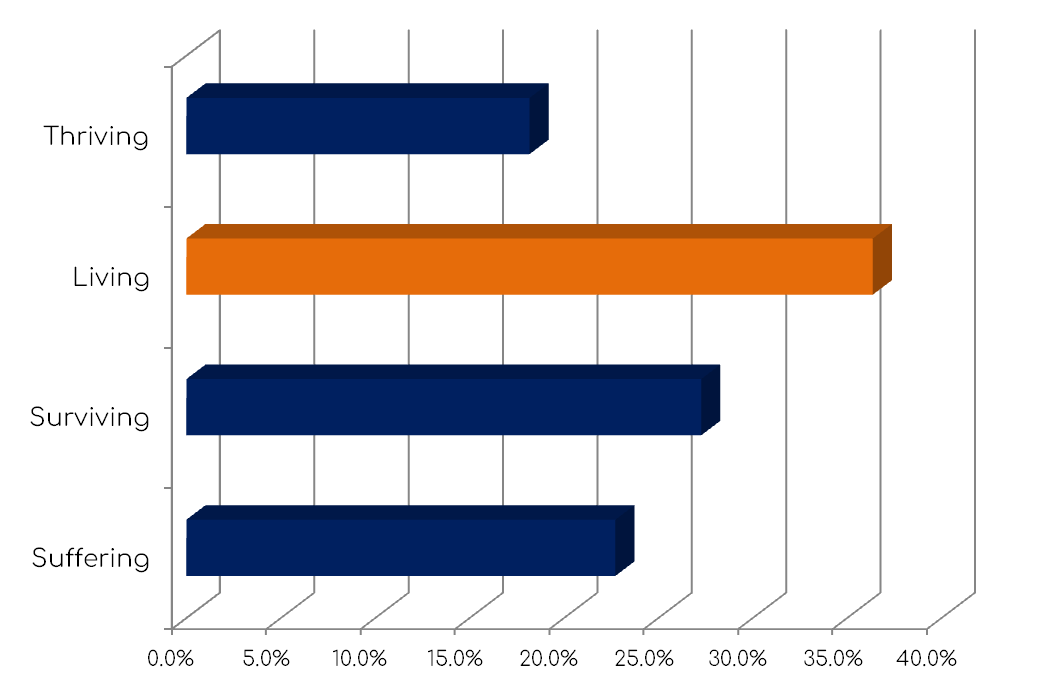
‘Living’ was the most endorsed category, and I’ll talk briefly about what this could mean. By and large, women feet they are getting their basic needs met. Things are ‘ok’ or quite average, but perhaps they could be better. There may or may not be a lot of emotional satisfaction in the process of getting by and getting things done. I see the main differences between thriving and living and as being anticipation rather than commitment to the daily grind, and a feeling of growth or forward movement rather than running in place. I didn’t get any comments on this from thrivers or livers, but I’m happy to learn if I’m missing something here.
Another thing I wanted to mention is that these are not fixed categories. As life is unpredictable, you can easily find yourself skipping around through your life, with the possibility of experiencing all four scenarios. I myself have experienced all but a feeling of thriving, and the most terrifying thing for me is that you can go from living to suffering in the space of a month. Without personal experience, I can only imagine that feeling that you’re thriving instills a sense of stability. I’ve never felt that before.
Is There a So-Called ‘Thriving Mindset’?
The quick and dirty answer is ‘no’. You cannot will or hope or pray yourself into financial success or excellent health. Conversely, being a realist or even a bit on the negative side won’t magically destroy your opportunities or outcomes in life either. Sure, to some extent we are all captains of our own ships, but a lot of you probably know damn well that you can do absolutely everything right in your life and still end up struggling in one or more areas. And while we might be able to work hard, eat well, develop great relationships and stay active of our own free will, envisioning success or joining the unofficial Cult of Positivity is not a magic bullet that will take care of everything else.
The ‘yes’ answer – that there is a Thriving Mindset – was likely concocted by the psychotherapy and life coaching professions in order to make money off of blaming and shaming you for your lack of prosperity and getting you to sign up for an expensive course of treatment or goal-setting program. One of the worst pieces of propaganda-slash-pseudo-intellectual-malarky I’ve seen out there comes from Class A misogynist, Friedrich Nietzsche: “To live is to suffer; to thrive is to find meaning in suffering.” Again with the suffering, right? I swear men are obsessed with pain and suffering – as long as it’s women who bear the brunt of it. The fact is that no one in the world has the one-size-fits-all model for how to thrive. There are many factors involved, many of which are completely outside our control, and some of which are completely controlled by men. As a result, I think it is difficult for women to achieve a state of thriving in this world. Two major things we see over time and all over the world in the data on various measures of prosperity is that women as a class experience significantly more poverty and significally more chronic health issues, especially depression and inflammatory diseases, than men. While men are more likely to die off earlier everywhere, women tend to develop issues that keep them alive, but suffering in multiple ways for very long periods of time. And this suffering has nothing to do with mindset and everything to do with being an long-oppressed class of people. You just can’t think or hope your way out of this.
What I’d really love to see is all women and girls thriving in life. I’d like to see a world where ‘experiencing challenges’ isn’t a euphemism for suffering, but rather a process of working hard towards a goal and having it pay off in the end. I want a world where living a life doesn’t mean just trying to get through it all only to find that there’s nothing waiting at the end, but to enjoy each day for what it brings. But that just isn’t possible in a world of male dominance and their female-suffering-based systems of capitalism, ‘we do it because we can’, and survival of the fittest.
♀️ If you care to support Story Ending Never, we are appreciative. ⚢




 Story Ending Never
You must be logged in to post a comment.