Blog Archives
N is for NPD (Narcissistic Personality Disorder) – Part 3
This post is part of the ongoing Alphabet Series. Listen along to my recording on YouTube and/or read the article below ♥♀
I was on the brink of turning 21 when I headed into one of the worst summers of my life. I had just finished my first year of university in a small city far enough away from my NPD family to escape casual family visits, and for the first and last time in my life, I returned to my hometown and my chief abuser’s house for the summer.
I hadn’t realized how much just 9 months away from a toxic environment would change me. I had hated high school, I had hated working full time as a secretary in order to earn money to go to school, but at university, my world had opened up. And more important, I finally noticed the extent of my mother’s abuse. Within 2 weeks of being back, everything fell apart. My parents had divorced when I was 17 and in the fall out, I threw myself into school, my younger sister quit high school, moved in with a drug dealer, and got knocked up, and my younger brother became invisible, although as a boy, he was the favourite child and was mostly left alone. But three years later, after I, the truth-teller and major threat to my NPD mother, re-entered the diminished family home, the shit hit the fan.
My brother and I had gone out with my father and his girlfriend and we got back to my mother’s house rather late at night. On the kitchen table was a picture my brother had drawn. My mother, who was nowhere to be found upon our return, had clearly found the picture and had left it out as a sort of warning. What she had discovered was a family portrait that included a woman that was clearly not my mother – wrong hair colour. Dismissing it, as it didn’t seem like a big deal to me, I went downstairs to my room to get ready for bed, but was interrupted by some shouting and door-slamming. I crept silently upstairs. The bathroom door was closed and I could hear my almost 16-year-old brother crying. Very unusual. And my protective rage flared up in me as I realized what had happened. And for the first time in my young life, I went on the attack. After checking on my brother, I walked calmly to my mother’s bedroom door and in a low and even voice, let her know what I felt. I used a few choice expletives – something she had never heard me do before. Then I walked downstairs. I didn’t get far as the dragon jumped out of bed, chased me to the kitchen and punched me in the stomach, screaming at me the entire time. I indicated that I was going to call the police since she had hit me, and mother countered with oh no, she was going to call the police because actually I was the one who had hit her. I didn’t have the insight or the language at this point in my life, but this was classic gaslighting.
Somehow, I ended up back in my room and I called my father, who immediately came to pick me up. I was emotionally frozen, not just because of my mother’s behaviour, but also because it was the first time in my life that I had stood up to her. I’ll leave out a lot of the detail here, but I’ll just mention that less than a week and a half later, I found out that my mother was going out of town, and I went to her house to pick up all my things and to drop off her key. But when I got there, I couldn’t find any of my things and my bedroom was filled with another woman’s belongings – in my drawers, on the unmade bed, and on the floor. In less than two weeks, my mother had replaced me completely, and not only continued to take the exorbitant child support that my father was paying her to NOT care for me – I didn’t live with her and I paid for most of my own education and living expenses even before this – but she was now taking rent from a complete stranger. It was at that point in my life that I cut off my mother completely, and over the next year, found a way to support myself financially 100% working several part-time jobs and going to university full time. My father wasn’t interested in helping me with money even though he made six figures a year, but he seemed to take immense satisfaction in now being in sole control of emotionally manipulating me. He was a narcissist himself, but had taken a back seat in the abuse while he was still married to my mother. My brother, whom I had defended, completely blamed me and sided with my mother – typical golden child. My sister, who hated my mother more than anybody actually, ended up siding with her in order to benefit financially after having her teenaged pregnancy. In the years following my break with the family, my mother went on a rampage contacting everyone I knew to tell them I was insane and every so often, she would recruit family members and whatever man she was fucking at the time to try to manipulate me by proxy in order to get me back under her toxic narcissistic control.
This is an example of the most extreme and difficult, but effective, way of dealing with narcissistic abuse. It is usually called ‘going no-contact’. It is the route most often taken by truth-tellers and scapegoats – those of us who are least likely to become enablers, even if we are highly empathic people. All ways to deal with NPDs are difficult, but I believe this one is most difficult because you will lose more than just the NPD relationship, if it is a family situation. Likely, you will lose most to all of the other family relationships because they are, for the most part, enablers and some receive financial and other perks in exchange for tolerating abuse. And I lost most of the people in my family in the aftermath, and deliberately went no-contact with my increasingly abusive narcissistic father when I was 27. Losing an entire network is hard. As a woman, especially if you aren’t straight, it will be even harder because the only way for women to gain any kind of pretend power or the pseudo freedom that money can bring in this world is to suck dick. Now, I didn’t get much financial support from my family, even as a child, so I was used to having to pay for what I needed. I started working and saving regularly when I was 12 years old. I’ve always been poor, but I learned frugality and financial creativity and resourcefulness out of necessity, especially because I knew from a young age that I never wanted to suck dick in exchange for food or a home. I was very clear that I didn’t want to end up like my completely useless patriarchal mother.
The other issue you experience with going no-contact is that you can’t talk about what has happened to you. Most people don’t understand what NPD is, and no one believes that mothers are abusive – despite what mothers claim. I learned very quickly to tell people the bare minimum – and a semi-lie at that – when they asked about family. My parents were dead and I was an only child. And honestly, these felt true in my heart. The bonus is that people feel awkward when they hear this and don’t ask any follow-up questions. This may sound harsh and this is really hard to rationalize as a truth-teller who values clear discussions of reality, but after a lifetime of gaslighting and shaming despite being the victim, you really aren’t interested in more of the same.
Now, I haven’t done what I probably needed to do to become a healthier person partly because I’m a loner and partly because, thanks to my father, I don’t really trust people in the helping professions, even if I see that they may have value for others. I didn’t learn about personality disorders in depth until I got to grad school in psychology and worked on a few projects with some clinical students. But I didn’t put it all together in my own life until my late 30’s. And actually, a lot of victims of narcissists don’t realize what’s going on until they are older and have lived through a few bad and repetitive abusive patterns and start looking for answers.
Myself, I spent a lot of time self-examining to figure out what was wrong with ME, thanks to how my psychologist father had pathologized me and my reactions to abuse. It wasn’t until I was in my late 30’s and met a woman like me at a youth hostel where I was work-staying. We had been talking about a scary domineering woman who had passed through the hostel and how we both had tried to avoid her and had felt some rather serious emotional reactions to being around her. This other woman gave me insight and recommended the web site Daughters of Narcissistic Mothers – it had helped her figure out why her life felt like a disaster and why she was so affected by certain kinds of women. I devoured the site wondering if it had been written about me. I had already read so much and even had a couple of degrees in psychology, although not clinical psychology, but I could never identify what I had experienced. But so much more work has been done on personality disorders since my youth, not all of it necessarily beneficial, I’ll add. But I now had a context for my experience. While it might have been nice to have had a support group at the time, just being able to identify the problem did so much for my healing process. I think I’ll always be vulnerable to narcissists, as a truth-teller and a woman – they are very good at targeting threats to their control and power. But I am now very good at identifying them and I avoid them when I can. I’m just not the kind of person who is able to employ some of the strategies I’ll talk about below as I’m a sensitive person and have a hard time compartmentalizing. I’m a resilient person, but I have my weaknesses and vulnerabilities. This is normal and it is perfectly okay to have weaknesses, but it is important to know yourself and what you are capable of dealing with. Personally, I don’t think we can overcome anything and everything. We can just manage problems. So don’t let anyone tell you how you should be reacting just because it works for them.
In my opinion, there are only a few paths you can take when dealing with NPDs. If you choose to go into therapy or if you live in a culture where family is sacrosanct, going no-contact won’t even be entertained as a possibility. For those in abusive romantic relationships, the vast majority of therapists will still promote heterosexual partnerships and the idea that there is a magical unicorn male out there who won’t abuse you. So, if you decide to leave a narcissistic male, don’t worry, there are still good men out there… But keep in mind my theory that NPD is just male behaviour on steroids. If you partner with males, you will experience a lot of the shit that narcissists inflict upon their victims, but to a lesser extent and in a way that is socially acceptable in heterosexual relationships. It is in the male nature to manipulate, parasitize, and gaslight women, even if they are not clinically NPD. In a workplace with an NPD boss or colleague, going ‘no-contact’ or in other words, leaving without looking back, is ideal, but for women, it is really difficult. But in all types of relationships, there are strategies recommended if you want to or have to maintain that relationship.
Therapy or Support
Like I said, clinicians and therapists make their money by selling hope. Not a one of them will ever tell you that you’ll never fully recover from abuse because no one would ever give them money otherwise. It would be more truthful for therapists to be honest with you and say, you will carry this deep wound until the day you die, but I can try to help you manage your damage. But that doesn’t sound so good, does it? Therapy also costs money, and not a lot of women can afford that. The cost, the potential for lies and false hope, and even gaslighting from the therapist him or herself are all risks that you need to think about before starting down that path.
Support is crucial, however. You can get it from different sources, whether a good therapist, a fellow truth-telling family member or friend, or a survivors’ group. The latter is probably becoming easier to find, perhaps moreso online. But just make sure that you see it for what it is. Most of these people have experience, but little to no expertise, in helping people with serious problems. Some of these people may be NPD themselves and are into manipulating the vulnerable. Be aware, don’t become enmeshed, and see it for what it is: a chance to talk about your brutal reality and share stories, relief at not being alone and realizing that you aren’t completely crazy (you still might be a little crazy, of course), and a chance to be listened to without judgment. You may also end up getting a few buddies who will offer support if the narcissist tries to re-enter your life and uses manipulative tactics to try to convince you that they’ve changed or feel some kind of remorse. Touching base with a supporter can help you see through the lies.
Compartmentalization
There is a tactic that is highly promoted if you choose to remain in narcissistic relationships, and some call it the ‘grey rock’ method. Essentially, you interact with the narcissist without engaging emotionally. In my opinion, this is compartmentalization. Somehow, you separate your feelings from what is going on. It is goal-oriented and it allows you to remain non-reactive, thus not giving the narcissist what they most desire: control and power. You stick to facts when dealing with them. They ask a question, and you give an informational answer instead of an argument, a defense, a counter-attack, crying or pleading, etc. If they make a manipulative and non-productive comment, you wave it away and focus on the productive.
Now, some people can do this. I can’t. I might be able to have a fact-based conversation, but it will be in my head and affecting my mental health and even my physical health long after the conversation is over. So for me, this is not a way to deal with someone long-term. It’s just not worth it. And it won’t work for other sensitive people either. And you don’t have to be ashamed about being sensitive. Our world really hates the emotionally sensitive – and I don’t mean people who create a victim status for themselves or need trigger warnings on everything. I mean people who have been chronically emotionally exploited and abused. You don’t heal from that overnight, and sometimes, it is just part of your personality to be highly attuned to and vulnerable to emotionality.
Healing from Abusive Women without Becoming a Misogynist
This is a really important topic for women who want to follow woman-centric paths. Patriarchy is about male dominance and the best way to keep men in power is to create division between women by isolating them, discouraging bonding and breeding distrust and hate. The role of mother in patriarchy is perfectly designed to do this. Unhealthy women are pressured and sometimes forced into breeding. They are isolated from other women, except perhaps other unhealthy women, and are focused on male needs and wants. And they are rewarded for breeding privileged sons and shaping damaged and heterosexuality-ready daughters. Many of us daughters are raised by mentally ill as well as patriarchally programmed women. We grow up learning how to treat other females badly in order garner valuable male support, and to expect insanity and cruelty from women, as well. None of this is natural, by the way, but completely normal and accepted.
But some of us come to see patriarchy for what it is, yet we have this lifetime of abuse by females. And of course, we continue to see it happen all around us every single day, even if we have managed to escape an abusive mother. So how do we overcome the abuse of our childhoods and focus on women without being overcome by loathing? I’ll tell you with all honesty, in the first few years after going no-contact with my mother, I sometimes fantasized about beating her badly just to dispel the pent up and impotent rage resulting from her dominating and destroying me in childhood so completely. It scared me as it felt so visceral, so deeply rooted in me, but did calm me down. And it was youthful anger – I no longer have those feelings and I never acted on them, I’m happy to say. But women don’t really have an outlet for their justified rage, and we are encouraged to suppress, accept and hope for better things. If women do act out, the most acceptable ways are to self-harm or to direct petty abuse onto other females.
Anyhow, I touched on this issue a little in my post, M is for Misogyny, Part II. Like with all problems, identifying what is going on and why it happens are the first steps in dealing with emotions and problems. I was able to see my mother as the daughter of a narcissistic mother herself, and a victim of patriarchy because she was a woman who was pushed into housewifery, non-contribution to society, and breeding despite hating children and being extremely mentally unfit to deal with anyone, let alone children. I saw her as enabled by a fellow narcissist, so much so that I still can’t tell who was truly pulling the strings in my family. And I am able to see all of this as a cycle I can break. I chose not to have children, not to support men, and to focus on promoting gynocentrism. I also choose not to pour my energy into patriarchal women or to forge relationships with women who abuse women. And that’s okay – I don’t have to love everyone. Ultimately, I know women abuse me because they see me as a threat to their comfortable addiction to suffering. Male domination hurts them, but the known, even if it causes harm, is always less scary than the unknown.
♀️ If you care to support Story Ending Never, we are appreciative. ⚢
N is for NPD (Narcissistic Personality Disorder) – Part 2
This post is part of the ongoing Alphabet Series. Listen along to my recording on YouTube and/or read the article below ♥♀
I did a little thinking after receiving an indignant and entitled comment from a YouTube user on the last post. He or possibly she was so disgusted at hearing a feminist perspective on NPD that they had to turn the recording off after a few minutes. The poor dear. I know, reality isn’t comfortable and can offend many people. People generally prefer lies and feel-good non-explanations for phenomena. But facing reality is necessary if you want to have any hope of actually solving problems. And NPD is a problem and does require a feminist framework if you want to understand it. So my thinking brought me to the following question – why must NPD be addressed within a feminist context? Very simply put, Patriarchy or the system male domination does the following. It pressures and enables women to pursue motherhood even if they are not equipped to produce or raise healthy children. It enables unhealthy men access to and control over women’s bodies and whatever comes out of those bodies. And it creates a problematic model of child ownership where an unhealthy parent or parental unit is solely in charge of a child or children without any accountability or external oversight. And outside of breeding, all societies reward aggressive and abusive male behaviour and allow women limited power if they exhibit or support male behaviour. How is this not problematic? This is a recipe for abuse, and it is only possible under a system of male domination.
Another reason why NPD is best viewed within a feminist framework is because of many of the similarities in treatment that a victim of a narcissist and a female in male-dominated society receive. Both narcissists and men in general are enabled and so many excuses are made for their abusive behaviour. Both victims of NPDs and women are gaslit and bullied when they try to come forward to describe their experience. Many of the tactics that narcissists use to control their victims are the same tactics that men use to control women. I’m not saying that all men are narcissists, but like I posited in Part I, I think that NPD is standard male domination patterns, but on steroids.
Early in my postgraduate training, I worked on various research projects on personality disorders, and since then I have done a lot of reading and exploration, as a survivor of narcissistic abuse, and I’ve never encountered a therapist or researcher that approaches these problems from a real feminist perspective. They can describe the issues, but they can never really provide adequate answers to the why and how questions, and thus, we can never develop preventative solutions. Psychologists just bandage the wounded. There are a few good reasons for this. First, all people are raised to elevate males and hate females and are inundated with woman-hate throughout their lives, and all psychological theories and resultant therapist training programs are rooted in misogynistic male thinking. So, true feminism isn’t going to make its way into therapeutic systems or even the education system. In addition, modern therapists who seek a following online do so primarily to make money. Adopting a fact-based, gynocentric approach to mental health (or any issue, really) is guaranteed NOT to make money. It can get you cancelled or put you in danger. If you alienate men, which can be achieved by simply calling them out on their provable, data-based violence, it will destroy any career you seek to build through social media. I’ve watched a lot of videos on YouTube on mental health issues, and even if the therapist him or herself understands the basics, they are ALL invested in promoting heterosexual relationships, and not a one will dare to touch sex bias in how women are affected by abuse or mental health issues, or will be truthful about root causes of anything. Some will touch on race and cultural issues, but no one will go near real feminism nor will they call out homophobic material left in their comments sections. I’ve even seen one or two ‘experts’ try to paint claims of sexism as oversensitivity rather than a legitimate complaint, which of course, is the kind of gaslighting that these people should be well aware of and that women experience constantly as the subordinate class in a patriarchal system. The failure to truly support women is not a surprise to me, but it is sad because as I’ve said many times before, suffering is not a necessary part of female existence and only happens because of male dominance and the system that results.
Okay, so having gotten that out of the way, I’ll briefly discuss the results of the poll I put on my blog and YouTube channel, and that will lead into the main topic
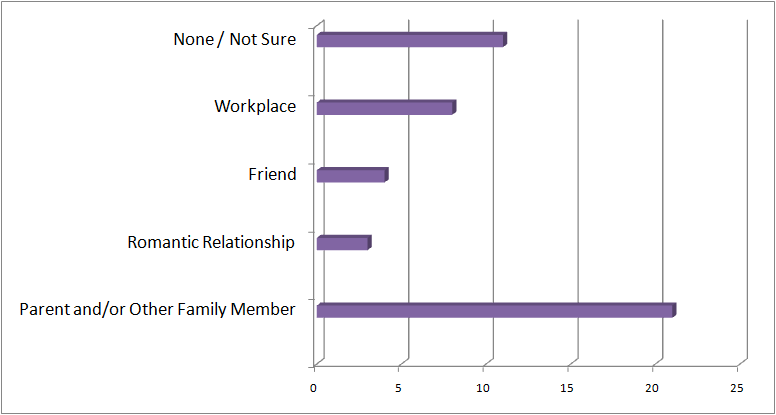
So I asked people to let me know in what areas of their lives they may have encountered someone with NPD just to get an idea of where we tend to encounter these folks. Note that the results are rough – I didn’t ask for confirmed diagnoses and the data are self-reported, so please don’t draw any causal relationships. But I will make a few observations.
First, I noticed that the most highly endorsed types of NPD relationships happened within families (especially with parents), and then in the workplace. This was interested and not unexpected. We don’t get to choose our families and are thus captive victims to whatever shit goes on there, especially in a world where breeding is not selective. If you want to escape NPD in your family, you have to go to very drastic measures, which I’ll get into in Part III. Workplace exposure has a little more freedom. You can leave a job, although depending on a host of factors in your life, it may not be the easiest transition. For some people, it may not be a big deal to find another job, but for others, you may be sacrificing your reputation or climb up a ladder or you may not have the financial means to quit without having something else in place. I firmly believe that women are more affected by abuse in the workplace, and our resumes and careers suffer when we are forced out of jobs due to stress and health issues, threats to our safety, and general career punishment simply for being women and especially outspoken or intelligent women who don’t follow lady-rules.
The other categories of friendship and romantic relationships were far less endorsed, and I think that is probably because we have so much more choice about these relationships. Unless you have been a chronically abused person who tends to fall victim to abusers, most people can avoid becoming trapped long-term in free choice relationships.
Of the types of treatment respondents experienced at the hands of NPDs, gaslighting was the most common, with blaming, boundary overstepping, and bullying closely following. NPD is about control and manipulation and protecting a very fragile ego at the expense of everyone else, and these tactics all serve to give the narcissist the upper hand in dealing with you, making you second-guess yourself and feeling like you have no control over what is happening.
So, let’s talk about the roles people in the lives of narcissists end up taking on. I’m going to address family and the workplace, primarily, but note that you can see some of these roles in any relationship with a narcissist. A lot of therapists talk about these roles as if each person involved in the system is assigned one, but it can be a little messier than that. Not all roles may be present. And there can be overlap and role exchange over time or situation. The roles can also have different effects on males and females.
The Truth-Teller vs the Enabler
When we talk about truth-tellers, we don’t mean the person who has no filter and just says what they think, no matter what. Rather, a truth-teller usually has high emotional intelligence and can often be described as being able to read a room or see through you. It’s a valuable skill that shows up in childhood, and as children, they’ll often bluntly state what they observe. Among normal people, this can be amusing or sometimes uncomfortable, but in a family with a narcissistic parent, an observant and truth-telling child is a massive threat. The narcissist feels shame and then reacts with rage and whatever punishing behaviours they use to regain the upper hand.
Truth-tellers quickly learn that pointing things out can get them into trouble, and many end up as loners (not always by choice) within a family, and later in the workplace. As children, they often have rich inner worlds, imaginary friends, escape fantasies, and dream of the day when they can exit the toxic prison they live in. Many truth-tellers end up becoming the family scapegoat and they usually have no support among family. They suffer anxiety and low-self-confidence and loneliness, although some may learn out of necessity to become extremely self-reliant.
I was the truth-teller in my family, and it has caused issues with NPDs in a few different workplaces, even affecting my career path. I swear I have the words tattooed on my forehead – people seem to know what I am even if I say nothing. Perhaps I am just not very good at ass-kissing or pretending to be blind to nonsense or outright abuse. I am also terrible at having superficial and/or subject-avoidant conversations, so much so that I’d rather have awkward silence than pretend. So it doesn’t surprise me that I prefer to work freelance or independently or with limited supervision. But I will say that I have managed to use what I consider to be an ability to great advantage in non-NPD situations requiring conflict resolution, and I feel it is somehow tied to my gut instinct when it comes to dealing with men who end up being threats.
Now, if the truth-teller is all about reality, then the enabler is all about lies. These are weak individuals, but they come in many flavours, and their actions serve to control their fear, keep the peace and/or protect the narcissist in return for rewards, safety, etc. I wrote a post on Enablers earlier in the Alphabet Series, so I won’t go into great detail here, but suffice it to say that these people are kind of like a shit topping on the shit-flavoured ice cream of the narcissist. The NPD abuses you, and then the enabler further harms you by shaming you and throwing in with the abuser. It should be no surprise that truth-tellers seldom end up becoming enablers.
The Scapegoat vs the Golden Child
A scapegoat is the person who is blamed when something goes wrong, even if they have nothing to do with it. Every narcissist needs a scapegoat because they never ever take responsibility for their bad behaviour, the mistakes they make, and they always need a target for their rage, even if no one specific is actually to blame. Truth-tellers often make convenient scapegoats because they are massive threats to the fragile NPD ego, and other family members may pile on as well to avoid being targeted themselves. But narcissists can target anyone for blame, even their greatest enablers. In some families, it is always the same person who is the scapegoat, but in others, members may each take a turn depending on the issue or their availability. And some people react to this treatment by trying harder to help or fix the situation, while others turn to bad behaviour to live up to negative expectations.
The golden child, on the other hand may exist in a family to serve a few purposes. The narcissist often places their hopes and dreams on someone, almost as if that child isn’t a separate person themselves. I’ve seen this play out in a few different ways, and there are often sex differences in how it works and how it affects the child. When the golden child is a girl, I find that she often ends up really neurotic and driven, plagued by severe anxiety, perfectionism, sometimes eating disorders. Later, in adulthood, these women can be a nightmare to work with, especially if you are female yourself. When the golden child is a boy, I often see lazy, privileged coasters. The parent talks about them as if they can do no wrong, and the boy gets used to the attention and the something-for-nothing treatment. As adults, these males expect the world to revolve around them, and they often get what they want because we live in a male-dominated world that rewards men for mediocrity anyhow. I’ve worked with both of these types of golden children; I even remember one male student I worked with in my undergraduate lab headed by an abusive NPD male psychologist was even nicknamed Golden Boy.
The other main purpose of a golden child is to use them as a weapon against threats to the narcissist. The golden child will be used as a standard to shame the other children, they’ll receive better treatment, more gifts or rewards, and more attention. There may be resentment among other children, and as a result, no bonds or alliances can form against the narcissist.
The Mascot vs the Lost Child
Like with the other pairs of roles, the mascot and the lost child are sort of opposites. These two roles are not about treatment, but how children may deal with a narcissistic person in the family. The mascot, which is a bit a strange term for me, tends to react to the constant tension and conflict in the family with a need to entertain. They seek attention and their aim is to break tension and make everyone feel better. It can be problematic later in life outside the family system as they don’t deal directly with problems and have developed a very thick wall of protection that can be hard to break down.
The lost child, on the other hand, doesn’t want attention at all. They retreat to avoid dealing with conflict. It doesn’t prevent them from being abused, however, but they don’t fight back or give the narcissist the satisfying ego boost they seek. They are more likely to be neglected, however. While the mascot may be able to get by in social situations later in life, the lost child may not develop the superficial social skills to ‘pass’ in workplace situations.
I’m going to close Part II here with the following. Although I didn’t go into great detail about each of the characters you may find in a narcissist’s life, you can probably see that there is nothing good that comes out of growing up in this kind of family or going on to work in a place where adults are abusing adults. It isn’t necessary, but it is inevitable when we live in a system where the right to breed trumps the right to live free of suffering. As it is abuse begets abuse. And in Part III, I’ll discuss how you can deal with narcissistic abuse, especially as a woman.
♀️ If you care to support Story Ending Never, we are appreciative. ⚢
N is for NPD (Narcissistic Personality Disorder) – Part 1
This post is part of the ongoing Alphabet Series. Listen along to my recording on YouTube and/or read the article below ♥♀
I had been planning to write about this topic for a long time as it ties into so many of the subjects I have already addressed and will bring up in future posts. As well, it is something that a lot of women have experienced as an unwilling participant, but have not been taught to recognize or deal with. And further, for many women trying to live a more feminist or gynocentric life, there are major challenges to overcoming abuse by women with NPD. Interestingly, this topic is coming up at a time when I’m currently experiencing some rather serious fallout from ending a year-long, toxic workplace relationship with an NPD woman and I’ll get into that in a bit.
As this is a huge topic, I plan to tackle it in three posts as follows:
Part I: This is going to be a bit of a personal story / discussion of characteristics of Narcissistic Personality Disorder.
Part II: Here, I’ll get into the people often found in the orbit of the narcissist and briefly discuss the results of my short poll, which is still open, if you haven’t checked it out yet.
Part III: In this final post, I’ll talk about how to deal with a narcissist, especially if she is female and you are trying to live a life focused on supporting women and girls.
So, let’s begin. And my story begins 51 years ago when I was born to a woman with Narcissistic Personality Disorder, who herself, was the daughter of a narcissistic mother. I can’t speak to the mother before that, but I can tell you that I myself don’t have NPD. I have other shit I deal with, but that is neither here nor there. What is important here is that like most to all psychological problems, there are both biological and sociological factors at play. So you can’t create a clinical narcissist out of nothing but a shitty environment, nor do all biologically predisposed narcissists behave the same way as if hot off an evil robot factory assembly line. So let’s give a rough outline of what NPD is, and then I’ll get into more detail about the traits and behaviours to accompany my story.
Like many descriptive terms related to psychology, the term narcissist is overused, probably thanks to the internet and sensationally titled pop psychology articles. Lots of people can be narcissistic and it just means ego-centric or self-centred and arrogant. We all know people like this and they are annoying, but that’s not really what we mean when we talk about narcissistic personality disorder. For a personality to be disordered, there has to be serious dysfunction in multiple areas of life, and no one knows this better than those who find themselves in relationships with them. To keep things shorter and simpler, I’m going to use the terms NPD and narcissist interchangeably.
A clinical narcissist displays a cluster of traits, namely manipulation, control, high emotionality, and cruelty. At the core, they have extremely fragile egos, and the protection of this ego dictates everything they do. They live in perpetual delusion about themselves, their importance and their abilities and have an irrational sense of deservedness. They are extremely manipulative in order to control the narrative and get what they need. They lack empathy and consideration for others, frequently overstepping boundaries. And they require constant attention and admiration and come across as arrogant and needy at the same time. And as I said, not all NPDs look the same. Some are very successful in life, and some are complete losers – although both are arrogant and feel like they deserve more than everyone else. Some NPDs are publicly aggressive and antagonistic and controlling, and others keep their abuse private and often come off as real victims to keep you off-balance, but under control.
At this point, you may be thinking, “Hey Storyending, this just sounds like a typical male to me.” And you are 100% right. No psychologist is ever going to agree with this, but I’ve come to think of NPD as Male Bullshit Syndrome or Permanent Male Syndrome (PMS), except in overdrive. All of the symptoms are typical of males, but are greatly exaggerated and extremely destructive. So males with NPD just seem like normal males, with a little bit of extra bullshit. This is probably the main reason is it vastly underdiagnosed in males. And afflicted females come across as total psychos to those who fall prey to them. Have you noticed that only the NPD female, not the male, is a favourite evil character in entertainment?
A Note on NPD Parents
Because society incorrectly sees breeding as a human right, any fucked up person, including NPDs are allowed to create, own and abuse children. Teachers and volunteers who work with children have to do criminal record checks (not that that achieves much), but prospective parents don’t. Makes sense, right? A narcissistic parent, especially when that parent is the primary caregiver, has the power to create some very, very fucked up kids – some with personality disorders themselves, and all with at least one other major issue such as anxiety, depression, addiction, etc. Narcissistic abuse, unlike other forms of abuse, is very difficult to describe to an outsider without sounding like one is crazy or ‘oversensitive’, and if the abuser is a mother, no one will ever believe you anyway, so most kids suffer for years and are gradually broken down and even come to think that they are the crazy ones. In adulthood, and in other types of situations and relationships, how one deals with narcissists will depend on how you dealt with the primary. And I’ll get into that in Part III.
Now, back to the story. So I was lucky enough to be born to a narcissistic woman and an enabling man who was also a fledgling clinical psychologist, and between them, they created an idyllic childhood defined by emotional abuse and manipulation. Once I was old enough, I was able to gain some control over my life, and I chose to deal with it by walking away from my mother at the age of 20 and from the rest of the enablers at 27. And I’ll talk more in depth about options for dealing with NPD in Part III and how there is no ideal solution. For now, let’s just say I have an inexplicable distrust of both controlling and domineering women and of psychologists, in general. And it has affected my professional life to this day, as I have a very low tolerance for narcissistic abuse and can recognize it almost instantaneously.
So I come to recent events. A year ago, in the wake of leaving China and other plans not working out because of COVID, I found myself badly in need of a job. And through a couple of friends, I ended up with an online teaching gig working for yet another sketchy and abusive Chinese and her Ukrainian husband. It very quickly became an emotional nightmare, first because the woman turned out to be a clinical narcissist with an abusive and enabling husband, and second, I needed a job, so I couldn’t just walk away despite my mind screaming at me to do so.
It was a year of almost daily manipulative and crazy bullshit, and while some people were able to brush it off, for someone who grew up with and managed to escape narcissistic abuse, it was so stressful that it ended up destroying my health. A year ago, although unemployed, I was healthy. I walked 8 km every day. I had lost weight intentionally. I had plans I was working on. I had a modest amount of energy. And I had found a place to live and adopted a rescue kitten. A year after taking the job everything good had been undone. I’d gained back all the weight I’d lost and put on more. I didn’t exercise at all. I didn’t sleep well. My breathing had become laboured even just playing with my cat or doing basic things around my apartment – something I’d not experienced before. I was having mild panic attacks regularly, and even benign messages from the employer were triggering anger and an elevated heart rate. I felt more depressed and powerless than usual. And I felt rage bubbling inside me with no reasonable outlet possible. In my mind, I kept setting quitting dates and tried to find psychological strategies for dealing with the stress. But finally, about a month ago, I woke up and experienced some odd symptoms, including a weird tight pain in my chest and back. But I went about my business and taught my classes sitting through it with a mild feeling of dread. Was this what is termed a ‘minor cardiac event’ – or a mini heart attack? I was entirely too young for this, and there wasn’t a history of heart disease in my family. Regardless, it was at that point that I decided that I was finishing the month and quitting this low-paying and highly stressful job. And as if to give me extra motivation that I didn’t need, the narcissist sent one of her most abusive messages to the teachers’ online chat group letting us know that we didn’t matter and she couldn’t care less whether we quit because she was so rich. She even made a passive aggressive reference to me letting everyone know that having years of teaching experience didn’t make one a good teacher. And she didn’t even know I was quitting at that point. Yeah, I was done. So, now I am once again unemployed. And the first week of November was like what I imagine doing a drug detox is like. I was very sick and couldn’t get out of bed. But I’m on the mend.
Anyhow, I’m going to get into some of the key behaviours that most to all NPDs engage in with their victims, and I’ll reference the asshole for whom I worked to provide examples. Remember that even normal people do these things sometimes. But NPDs do them regularly and they do them to protect their fragile sense of self and to control the narrative that gets them what they want and need.
1.. Bullying, belittling, infantilizing and humiliating. This can be done publicly and privately. It is about manipulation, control and putting you in your place and feeling small, embarrassed, helpless and worthless. It is also done to build up their fragile ego by highlighting your tiny faults, a single, long-ago past mistake, or by completely fabricating something that makes you look ridiculous and makes them look superior. They may even add humour to your embarrassment to curry favour with their supporters, or may try to show you and others how your faults victimize and burden them. My boss would regularly embarrass the teachers in online chats with students’ parents. Instead of supporting teachers if parents had questions or complaints, the boss would make nasty and embarrassing comments that we could see, but she wouldn’t address us directly. She would file away small things that we did wrong one time, and use it as evidence of our incompetence both in direct battles with us, and behind our backs in conversations with other teachers. Only in conversations with other teachers did I find out some of the lies she told about me. It was really weird, but I grew up with this kind of shit, so it wasn’t new to me.
2.. Gaslighting. This is a must-do for the narcissist. Here he or she rewrites history and causes you to question your version of reality. The sole purpose is to disarm you as you have clear evidence of their faults and mistakes. So they will lie about what happened, they will pretend they don’t remember what happened, or they will accuse you of overthinking or misreading a situation or comment. And they will do it in a condescending way or will fake concern over you stress and emotionality. In the end, you don’t feel clear about what actually happened, and the less sure you feel repeatedly, the less likely you are going to arm yourself with facts and fight back. My boss would regularly tell us that the technological problems we had with the software we were using were not real tech issues at all, but something we did wrong, the unspoken implication being that we were stupid or even lying to get out of working. She would always say that none of the other teachers was experiencing these problems. Of course, this wasn’t true. The software constantly had problems, and my boss didn’t want to deal with it or take responsibility for choosing shitty software.
3.. Externalizing responsibility or blaming others for their mistakes. NPDs can’t handle legitimate criticism or even just a statement of fact that shows them to be imperfect. Nothing is ever their fault. They are constantly victimized by the world and everyone in their lives. My boss demanded immediate responses to messages and would harass us. But these rules didn’t apply to her, even if we had emergency situations during business hours. Despite being very rich, she refused to hire administrative staff to handle communications or class emergencies. So what frequently happened is that she wouldn’t respond within even 24 hours, sometimes upwards of a week. And for me, towards the end, sometimes she wouldn’t respond to me at all. But there were always excuses. She would complain about parents sending her direct messages instead of putting them in the group chat so that the teacher could see it and handle it. She was in demand and over-burdened, the poor victim. No one would help her out or understand her situation.
4.. Disregard for boundaries. NPDs don’t feel empathy, even if they can fake it on a superficial level to garner admiration. They don’t see people as equals worthy of respect and consideration. For NPD parents, children are just extensions of themselves and aren’t treated as separate individuals worthy of privacy. So, to the narcissist, other people’s belongings and secrets and time are public property, which they can access, take, share or give away without permission. ‘No’ is not a word that has any meaning for the narcissist, and using it can inspire a lot of rage. This wasn’t a big issue at my online workplace, other than my boss feeling entitled to demand unpaid work or to schedule my time without asking me first.
5.. Shunning and grudge-holding. This is a common method of punishment used by the narcissist when someone dares to challenge them in some way or if you inadvertently manage to be better than them, especially if people see it and acknowledge it. This can be very confusing and devastating when NPD parents do it to their children. Withholding love or attention over what amounts to nothing is pure cruelty and I experienced this many times with both my mother and my grandmother simply for having contrary opinions on completely irrelevant topics. You learn very quickly not to have opinions. You can also be publicly humiliated and shunned at the same time – this happens when you are present in a group and the NPD has stopped talking to you, but talks about you in a negative way. Like I mentioned above, during the last month of my employment, my boss had stopped responded to my messages for some reason, but she would make passive-aggressive comments about me in the teachers’ chat group.
6.. Denial of your needs. If others have needs, then it takes attention away from them. Narcissists need constant acknowledgment, approval, attention, praise and admiration in order to keep up the version of reality that they are incredible human beings. To see that others have needs chips away at that false narrative. Relationships are not reciprocal, although narcissists can definitely paint them as so. But in reality, the energy must flow one way, and you will eventually find yourself depleted and unfulfilled in any relationship with a narcissist. My boss would not allow days off. Some of us were working 7 days a week, and that can get mentally exhausting over time. Myself, even if I only have 1-2 classes, I am thinking about work as soon as a I wake up. I can’t disengage. I never did ask for time off, but I know some of the other teachers did. And the rage it inspired in my boss was mind-boggling to me.
I’m going to end this here. As I mentioned, Part II is going to look at the players in the narcissist’s orbit. Again, if you haven’t done the short poll on NPD experience, have a look. I’ve also written about antagonism and there is an old post on male weapons against women, which has overlap with narcissistic tactics and lends support for my theory that NPD is just hyper-manliness.
See you soon for Part II.
♀️ If you care to support Story Ending Never, we are appreciative. ⚢
New Survey on Experience with Narcissistic Personality Disorder – Participants Needed!
I’m preparing for an upcoming post on Narcissistic Personality Disorder in a feminist context. Anonymous votes as well as comments would be appreciated ♥♀
Please answer based on dealing with people who are ‘regulars’ in your life, rather than one-offs, randos, or people who exist on the periphery. Most NPDs don’t have an official diagnosis simply because they tend not to admit they have a problem – everyone else is the problem. You’ll know you’re dealing with one of these folks because your relationship revolves around their constant need for praise or acknowledgement and huge sense of self-importance, as well as bullying, antagonism, lying and rewriting of reality.
A Is for Antagonism
Story Ending Never’s Alphabet Series is now on YouTube in audio form. Come get your dose of weird Canadian accent 😉 You can listen along to my recording on YouTube and/or read the article below ♥♀
Happy new year. Does it feel like a new year? In many ways, no. This effing Virus is well into its second year now, and many of us are bored, depressed, not too hopeful, wondering when things will go back to normal, or whether we’ve got a new normal. Some of us are seriously isolated. Myself, I haven’t had an in-person conversation with another human that lasted longer than 5 minutes in months – I’ve noticed that people, especially women, seem to have a serious aversion to speaking to middle aged and older women. We’re invisible. But it’s more than that. It almost seems like there is a discomfort and dismissal on the part of those with whom you are trying to engage. It is hard to explain. Strangely, everyone seems to want to engage with weird men of any age, even when they stink to high heaven, are narcissistic, talk too much or too loudly, are offensive, and add whatever you want to the list. Seriously. I just can’t understand why it is more attractive to talk to some repulsive, self-centred pervball, but not to a friendly female who isn’t gaming to rape you or suck your energy with unbridled egomania and scrotal tall tales of imagined accomplishments and prowess.
In addition, I’m finding it really hard to catch the eye of fellow sisters while out for a walk on the street or walking trails – something I usually try to do no matter where in the world I am. I get the distinct impression that there is this bizarre notion that connecting with fellow humans, even just through eye contact, somehow puts you at risk for contracting The Virus. I used to live in the place where I currently am, and it’s not an unfriendly place, generally. But it feels very different here than it used to. Paranoid. And no longer a community. Selective disconnect.
Anyhow, I’m totally off track, but my excuse is that it is my first post of the new year, so some preamble was warranted. I wanted to kick off an hommage – or perhaps I should say femmage, as I love franglais and neologisms, both – to Sue Grafton and her Alphabet series. Years ago, I fell in love with Kinsey Millhone, private detective, with her minimalistic lifestyle, low income, and creative tiny house living space. Her only fault was her constructed and frankly unbelievable heterosexuality – she really never came across as anything but asexual or lesbian to me, but luckily, you could just flip a few pages to skip over the luckily sparse sexual content (thank you 1980’s – it would be a different story today à la 50 shades of shit).
We’ll see how far I get. I’m kicking it off with A is for Antagonism. There is no recurring character, and this isn’t a novel. And jeez, there is no mystery in what I write, despite the fact that most women just don’t seem to be able to figure out why men do what they do and why they themselves just can’t stop spreading their legs for them. Mystery is not the same thing as willing ignorance and cognitive dissonance, let me tell you. Open your eyes to reality and the privilege you orbit is no longer possible. Case closed!
Now before I get into it, there are tons of A-words I could have chosen here. A is for asshole, assault, aggression, arrogance, affirmative action, ‘alleged’, abortion, and more. But I chose antagonism, a highy underappreciated word.
So let’s go. Very simply put, antagonism is active hostility or opposition. Think of someone who seems deliberately to disagree with everything you say, or someone who pokes at you, saying provocative things that seem deliberately geared towards riling you up or getting some sort of reaction (anger, tears, defensiveness, etc) out of you. Interestingly, in literature, the ‘antagonist’ is typically seen as a villain, nemesis or chief opposition to the hero of the story, designed to cause problems or allow for a plot to exist at all.
I want to talk about antagonism in two specific, but not necessarily unrelated, categories: Male communication styles and Narcissistic Personality Disorder (NPD).
- Male Communication Styles
Let me draw from one of my ESL lectures on language and communication – I tell all my students that the purpose of language is to try to get what we want or need. It is one of human’s most basic and useful tools. If you don’t communicate, you don’t get what you need, from trying to find food or a toilet in a new place to trying to get a job. Now, to understand how males typically use this tool outside of toilets or getting directions, let’s cover a few truths. a) Males are both wired and socialized to believe that they deserve. Everything and anything they need or want becomes crucial and deserved. b) Males are also wired and socialized to be aggressive, so getting what they believe they deserve is best achieved through aggression of one form or another. c) Most males realize on some level that they aren’t important, have less to offer the world than females, and could be done away with without serious repurcussions in the long run (obsolescence). Most males can’t articulate that, but they know it on some lizard brain level and use aggression and a focus on ‘deserving’ to cover up their biological inadequacies.
But back to language. All of the above factor into the way males often communicate, especially with females they see as threats to their fragile egos in an attempt to prove that they are important, and better, and deserving, and not obsolete. An aggressive communication style is often used on perceived superior women (e.g., intelligent, educated, non-naive, older, uninterested, extremely attractive, and/or sexually unavailable women) and is usually manifested as antagonism. Now, some men use antagonism as a bizarre, but often effective (why? ask a hetero chick, cuz I don’t get it…) means of flirting. But antagonism is most often used by men as an attempt to disarm women, to steal their energy, and to divert their laser focus away from the inadequacies and flimsy lies and exaggerations of said male. Men will question and/or disagree with and/or dissect every statement a woman makes in a conversation. He will pick apart decisions she has made and is describing to him, and criticize everything about it in an attempt to make her defend herself or even fall apart. He will goad her to prove every detail she states, often expecting citations of studies or data. He will often ask her to recite lists of things to prove the extent of her knowledge on a subject and pounce on any error she makes as proof of her inadequacy, even a subject on the outskirts of the topic of conversation.
As I look back, I have have had sooooo many interactions of this sort with males through my life. Now, I’m not surprised – I am often a threat to men as I am smart, educated, well trained in pscyhology, sexually unavailable, I see through bullshit easily, and if I am feeling brave and devil may care, I can give better mindfuckery than I get. I am a massive threat to all insecure men who think they deserve and are used to most women giving them literal or figurative blowjobs for existing. Interestingly, the abusive male living in the house I was renting in when I first moved back to Canada spoke to all the women in the house using this style. I remember one specific conversation involving him, myself, and one of the cock-whipped hetero women, where the male kept picking at the latter over something she did that she was telling us about. She accused him of being jealous, but I countered with an accusation of being antagonistic. Only a month or two later, after he started making threats against my physical safety did I start putting the whole shebang together – which brings me to my second category of antagonist.
2. Narcissistic Personality Disorder (NPD)
It’s important to note that while many males employ antagonistic communication styles with women, most of these guys do not have NPD. Antagonism can just be a way that males deal with their usually subconscious awareness of their inadequacy and obsolescence as males. Also, note that narcissism and NPD are not the same. You can be a narcissist (very self-centred, vain, selfish) without a personality disorder (ingrained personality pattern that disrupts your day-to-day functioning and relationships). Both males and females can have NPD and thus can be antagonistic, but there are almost double the number of male NPDs than females (likely more because we accept narcissism and abusive behaviour in males and thus may not suspect that a male is anything but normal), which makes sense if you understand the disorder and the biological reality of males. As an aside, published research shows that young people, males, blacks, and, to a lesser extent, other minorities have higher prevalence of lifetime NPD than do older people, females, and non-Hispanic whites. You can google all that if you are interested – myself, I’m not getting into the whys and implications of race or age relationships with narcissistic disorders here – my focus is, as always, on male bullshit and how it affects women and girls. I have a great deal of personal experience with NPD family members, and what I will say is that the abuse they dish out is worse and more damaging to the core self than physical abuse. Most survivors of narcissistic and physical abuse will also tell you that. I’ll write more about my NPD experience in another post.
Antagonism is a chief trait of narcissists, and specifically, those with Narcissistic Personality Disorder (NPD). The arrogance, constant arguing, and pathological need to exploit people are warning signs that you are dealing with a very dangerous and destructive person with a problem that is likely never, ever, ever going to change no matter how much you try to help them.
Conclusion
Regardless of whether you are dealing with a weak ass male with ego problems or a true blue NPD, my advice is to get away as soon as you can. If you are stuck in a relationship (family, work situation) with them, you have a decision to make: develop strategies that will allow you to reduce the effects of antagonistic attacks (or avoid them as much as you can), or get the hell out. I always do the latter, but it comes at a very high cost. Worth it to me, but you have to weigh your options according to your own needs.
♀️ If you care to support Story Ending Never, we are appreciative. ⚢
Happy and Safe Christmas Greetings
Trust me, I have more heady stuff in the works, but I wanted to send out a short message to all women on this Christmas Eve. I don’t normally send Christmas greetings, but I’m working through my complicated feelings about the holiday. Mother made it miserable in childhood with her covert narcissism and materialism. Father destroyed any cultural enjoyment in early adulthood as over-compensation for and white guilt over existing in predominantly British Canada, with British traditions, when he married a Jewish woman. And then it has been years of aloneness at a time that is expressly devoted to families, coupled with living for years and years in a non-Christmas culture (Asia). Normally, I was working on Christmas Day. I didn’t have to think about it.
Last Christmas, I was in the US, abandoned by all housemates and thus alone. This year, I’m in Canada in my weird, asocial hostel situation. Interestingly, most of the people sending me greetings are my Chinese friends and former students, the sweethearts. But I acknowledge that despite my aloneness and mild loneliness, AT LEAST there are no male abusers ruining everything. But I divide my thinking as follows:
a) it is okay to observe cultural rituals as an atheist, and Christmas is as much a cultural holiday as it is a religious one. Christmas is Pagan in its origins, taken over by Christians, bastardized by capitalists, but there is this really nice cultural aspect of the holiday that non-capitalistic, history-enjoying atheists can revel in or at least observe with appreciation. I’m in the long process of healing from the Christmas mangling of narcissistic parents as well as white liberal race- and culture-shaming, and finding my own associations to the holiday. It is interesting. And welcome. I’m sick of being part of the only cultural group on the planet pressured to deny my culture.
b) Equally importantly, I think about all the women and girls in forced family situations, especially during this weird COVID time, doing most of the work, engaging in unwelcome interactions, stuck for days with unlikeables and keeping a brave face. Holidays can be tense and stressful at the best of times for many people as one deals with rituals that are forced rather than cherished, and coupled with drinking, it is not always a fun time. Myself, I removed myself early on from family abuses, but not all people are willing to take such drastic steps to preserve mental health because it is hard to weigh which will end up being worse – being completely alone, isolated, silent and unwanted; or being abused, but belonging to a group. What a choice, huh?
Anyhow, I’ll end this by wishing you all a Merry Christmas and hoping you get through the holiday safely and remembering that any gaslighting or manipulation or general nastiness you may be exposed to by toxic family members is not about you at all.
♀️ If you care to support Story Ending Never, we are appreciative. ⚢
Getting Inside the Head of the Head
I’m gearing up to a big post on rape. I’ve been reviewing the data from the fun little quiz that I designed recently (which is still open if you care to take a few minutes out of your day and click the button) to get some ideas about diluted feminism (larger context: The Ice Cube Effect and Feminism Dilution).
I’ll be posting soon on a few interesting things I noticed, namely the overwhelming misunderstanding of what rape is.
Today, I’m preparing for teaching, which starts up again tomorrow, and also procrastinating a bit by listening to Mancheeze’s live meet-up/broadcast on prostitution. Every time I read about or listen to stuff about male depravity – anything having to do with porn, prostitution, violence against women, etc. – I’m sent into a very important, unmaintainable, self-preserving, and ultimately stressful state. It is a state which, if maintainable, would help women quit men for good (which some of us have managed). It is a state that I can only describe as being the chilling or ice-cold, crystal-clear awareness that men absolutely hate women. There is no other way to describe a human who can take pleasure in any of those things that women only do because they are desperate or dependent. I’m not going to get into how all those things are harmful because it is a truth that has been described elsewhere in great detail, and as such, is both Feminism 101 and not debatable to me. Anyone who can’t see the harm to women in marriage, prostitution, pornography, BDSM or any of that line of male domination business is no friend to women. And I don’t get into discussions with them. Men who engage in or defend these unassailable ‘institutions’ hate women. Period.
So when I enter these intense, short-lived states of being highly aware of the male hate that absolutely surrounds and suffocates me and every other woman on the planet, sometimes I try to imagine what it would be like to be male or to live like a male. In order to do this, I try to imagine putting at the centre of my motivation and my entire existence a single body part. That single body part guides how I treat other people and how I see myself. It is hard to know whether I love that part, hate it, worship it, or have some complicated mix of all three, but what is clear is that catering to that body part requires that I do harm to at least one other person. How could narcissistic self-love not harm others? So I design my relationships to cater to that body part. My sexual interactions with others revolve solely around that body part. I design and support a world that caters to my body part to the detriment of other people who don’t have that body part. And I defend my body part and the world that caters to my body part against (perceived) attack, questioning, demands for justification and reparations for those who suffer because of them. I defend myself using violence, threats, arguments about the rights and supremacy of my body part. My body part is more important than the lives of millions. And the government, the law, the medical establishment, and every other power structure in the world agree with me.
In other words, cock is king.
In order to get inside the heads (either one) of men, one must put the supremacy of a single body part (the penis) at the centre. That is the best way I can understand how men operate. And I think that women really can’t see men for what they are – apathetic, narcissistic and sometimes sadistic destroyers with a single body part at the centre of it all directing the show/game/war – because women aren’t capable of putting a single, selfish body part at the centre of their pleasure at the expense of the rest of the world. And for that matter, women don’t really have an equivalent body part that can deal the damage that the penis does.
♀️ If you care to support Story Ending Never, we are appreciative. ⚢
What Does It Mean if I Find You Neither Endearing nor Horrifying?
Still travelling, still stuck in Doodville. Two more nights. Like infants, the doods demand constant attention and to suck at the collective tit of Woman. Some more than others. Most women deliver. Fawning. Patiently listening with an interested look. Cooing, clucking, nodding. Reassuring. Building up their confidence and egos. Laughing at their rape and ‘dumb ho’ jokes. Tee hee, you’re right, girls are so [insert misogynist stereotype here]. For the pathologically narcissistic of them, you could be lying there, clearly dying, with a knife protruding from your throat, and they’d still keep up with their demands on your energy. Yap, yap, yap.
I’m puzzled and perhaps only slightly amused by a new dichotomy presented to me by an egotistical, but untalented, ‘travelling artist’. He fascinates himself. He is tickled by what a jerk he is and its effects on the women he comes across during his travels and the female students he instructs (apparently he teaches some art class somewhere – details apparently not necessary to the casual inquirer, I discovered). He fully admits with a scary, psychotic laugh, that he enjoys how he treats people. Disapproval, insults. He said it makes fledgling artists better and they usually thank him later. Who knows if that’s true. We live in a mandatory S&M world where abuse is seen as positive attention and even love. So maybe he’s right on a surface level.
But Artiste says that in general, women either find him endearing or they find him completely horrifying, both of which he enjoys, but he says he clearly prefers the former. This means he gets laid, although, I suspect, given how this world brainwashes women and as evidenced through every bloody romantic comedy out there (those misogynists are so damned sexy, aren’t they?), those horrified women let him fuck them too.
But where do I fit in? I’ve thrown this guy for a loop because I find him neither endearing nor horrifying. He is boring, typical, standard, an EveryMan. And my reaction, or perhaps non-reaction is the better word, to him clearly rubs him in a way that he is not used to. I’m waiting for Gowan to pop out of nowhere and sing the chorus to ‘You’re a Strange Animal’. Artiste waxes on loudly about himself to anyone who enters the room. I can see him looking at me from the corner of my eye. “Why isn’t she paying attention? I don’t understand how this reaction fits in to my schema.”
This morning, he sat down across from me at the breakfast table, and I didn’t look up from the newspaper and my coffee. Somehow, even as he loudly started announcing things about his newly shaved head and the reasons for doing so, and how often he does this, and how much time the hair takes to grow back in, I registered nothing. I mean really, who gives a shit? I was busy reading about a local firefighter who had taken a teenaged girl as a sex slave, raping her continually. She got away and is telling her story. She will be labelled as a whore. You can see the set up in the language. “She had sex with him many times…” I put the paper down before finishing. I left the table and the hair monologue. A woman from the room I was staying in came in as I was preparing to get up, an apparent ‘nurse’ with tracks and several healed, self-inflicted cuts on her arms and wrists. Ignoring me, she entered the ‘he’s endearing’ camp and was enticed out to Artiste’s van to look at his collection of masterpieces. He has enough groupies. I’m not one of them.
Look at my hair cut, I’m endearing/horrifying, pay attention to meeeee, trusted community protector rapes teenaged slave repeatedly, teenaged girl is a slutty whore, not a victim… its all on the same continuum of male domination and narcissism and violence, violence, violence against women. It’s the sea we’re all forced to swim in.
Can someone please make it all stop? Make men stop. Make them accountable. Take away the entitlement. There aren’t enough goddess sessions to counter it all. What does it mean that I’m bored and tired rather than endeared or horrified? I think it means that I’m opposing the social order. I’m behaving naturally, and it’s a very simple, but threatening, position to take.
♀️ If you care to support Story Ending Never, we are appreciative. ⚢




 Story Ending Never
You must be logged in to post a comment.